Thursday, 14 September 2017

Being rich and pally with God for a long long time.....

Here in Burgos in northern Spain, for about nine hundred years, the super-rich (kings, queens, constables, bishops, priests etc) had access to more or less unlimited wealth which they took from the poor. They spent this money on creating a church for themselves where they could display their money, power, holiness and taste, and show off to their friends and relations.

It was not a small regional project.


They scoured Europe for the very best architects, designers, sculptors, painters, carvers-in-wood, gilders and so on, and set them to work. They started in about 1221 and seem to have had the greater part done by about 1450 - maybe 1500.  This was while we (in England) were still marvelling at the concept of making houses out of brick.


The staircase incorporates designs by Michelangelo and was the model for the stairs in the Paris Opera 400 years later.

Door to the cloister - added in 15th/16th century to a 13th century arch

The result is one of the most extraordinary buildings in the world. And saying that in Spain which is stuffed full of huge cathedrals really is an accolade.


Not only does it knock your socks off in every direction, it also sends a powerful message about how things have been in the world for all of modern times, and how (I fear) they will be again.   Churches are for rich people.


They are display cases for vanity and power.  They use the attractive idea of glorifying god as a channel to divert people's attention away from what is really going on.  It is where the pious and impious rich can arrange to have their bodies interred (viz every parish church in England).

Not one but two towers surmounted by vaulted glazed ceilings

Chapels made for queens, kings, bishops, their families, and friends... all with glorious ceilings and all very early
Burgos is a supreme example of how to do it. When you see the acres of exquisite carving, the lavish use of gold, the beauties of the design and the astonishing uplifting serenity and excitement of how it's all laid out, you also know that no peasant would really have been welcome in such a place. I really wonder if any ordinary outsiders were ever allowed in (until modern tourism sanctioned by UNESCO was invented. Thank you, that will be 6€ to come in).

So, it was a strolling ground for princesses and courtiers. It was a place where lords and kings plotted which aristocratic or royal female child would be sold off to which aggrandising aristo. It was where god slotted in nicely thank you, to keep it all going.

Just look at it.

As a matter of interest, the medieval lord known as El Cid is buried here, somewhere.


There are dozens and dozens of wonderful paintings now displayed in the Museum, where hoi polloi like me can wander round and look. The commentary on the headphones is not bad but enunciated in a ghastly pious sing-song voice by two presenters (m and f) who alternate. This undoubtedly pleased the patrons (clergy) who commissioned it all but left me feeling very squeamish. There are many beautiful madonna-with-child images, and I also liked the arrangement of all the legs in this rather violent painting. I feel the artist reckoned he could do a good leg and persuaded a patron to let him get on with it. 


Tuesday, 12 September 2017

Apart from shortage of time, I find it has been quite hard to assemble my thoughts about the last 3 days, and I wonder if this is a delayed result of the car smash last week - my brush with death.  In fact we have had rich and stimulating times, travelling through the most spectacularly beautiful mountains, camping and wandering around in Huesca, and then coming back into France for a day or so. Visually it has been entrancing. So many thoughts and ideas have been flooding through my mind, I knew I couldn't record much of it... so there's this sense of ideas lost, and opportunities missed.  Something sad as well as uplifted, dark and light, down and up.
(Each time we have been up in the mountains we have seen eagles - huge and solitary - and flocks of great vultures.....)
One powerful thread was thinking of Katherine of Aragon, that extraordinary redhead who was married into the Tudors as a child because she brought more lineage and credibility than they had without her, having two direct lines of legitimate ancestry from John of Gaunt whereas they were basically illegitimate. If she could produce a male heir for them, that young man would have a claim to the throne of England which would be completely upheld by all the other crowns of Europe, and the Pope.
She came from this kingdom of Aragon, whose beauties we have been dazzled by in the last few days - great mountain passes and folds, rivers, cities, estates, castles, and pride. She was born in Madrid, educated, dedicated and and intelligent.
What she thought when she arrived in the lowlands of southern England one can only imagine - how low, dark and cold it must have seemed compared to the grandeur and brilliance of her own lands.


Among her courtiers was one John Blanke, a trumpeter - thought to be the first African black man to arrive in England in those days.
She was married by proxy, and then in reality to Arthur, Prince of Wales - but he was overtaken by a fever and died within a few months and she was left widowed. In order to keep her all-important lineage in the family, Arthur's father considered marrying her himself but her father objected, so she was then paired with Arthur's brother, Henry - five years younger than she, and destined to become the Donald Trump of his age - Henry VIII.  She bore numerous children, but only one survived - Mary, a girl.  As we know Henry took matters into his own hands when he became infatuated with young Anne Boleyn... and Katherine was dumped, never ceasing to protest, and never accepting her divorce.  She commissioned a book about the education of women..... 
As we passed through some of her lands here, we thought about her, and saluted her, and her country.
The new roadworks are a wonder - there is no shortage of space so they can spread out and do what they want - it is a paradise for spaghetti-junction lovers. The roadworks are also adorned with striking and attractive works of art. They are proud of their roads and rightly so.

Iron Horse in Aragon

From Torla we went west through the mountains to Biescas (where a squall of wind demolished some of the market stalls in front of our eyes), and then down to Huesca - to camp for a couple of nights in what turned out to be an urban campsite - something out of Celesteville, next to the football stadium and the swimming pool - but now surrounded by blocks of apartments. As we have seen before, the population of Spain no longer wants to live on the plain, but to flood into the cities for the fun, the footie, the schools, shops and amusements. Every town has its new forest of accommodation, tall suburbs, blocks and blocks of flats.
That mighty wind came rushing past us, day and night, bringing sporadic rain but a lot of roaring and flapping. The small plane trees planted through the campsite offering shade and privacy were bashed and battered and the wind spanked through the leaves and gave us a non-stop orchestral howling.....


We spent Sunday wandering round the sleepy city, having the place almost to ourselves.

The cathedral has a very good alabaster altar-piece,


but is mostly unusual in being rather late in date. That's because the Christians (in a practical spirit) just used the mosque for two hundred years longer than anyone else did, until some king or other protested and thought a purpose-built church would be a good idea. The only bit of the original mosque thought to survive is a part of a doorway, but not open to the public on Sundays.
The museum (near the university, and housed in a lovely octagonal building) is described on TripAdvisor as ' not very interesting' but we beg to differ. It is exemplary as to its displays and quality, offering a warm story of the history of humans in the province of Huesca - Old Stone Age, Upper Paleolithic, Meso, Neo, Bronze, Roman, and the rest.... lovely stone and pottery and then into the modern age.
A hand from a Roman statue - and my own....
Half way round, you get diverted into a suite of rooms once part of the royal palace - beautifully cleaned up, and partly used for a modern art display. Since one of the lower rooms is said to have been where a monk called Ramiro II chopped off the heads of some rebellious gentlemen, the present art installation of ghoulish heads and ghastly noises is absolutely appropriate.


The chapel above this charnel house is very lovely with carved capitals and when an Aragonese princess called Petronilla was given as a child-bride to the Count of Barcelona......    Ah, the child brides.


The museum has some stunningly beautiful madonnas - two carved effigies with the holy child, and one particularly lovely painting showing musicians around her, playing heavenly music.


We fled the wind and the roaring plane trees and came back up to the Pyrenees.


It was fun to stop at Canfranc - the railway station where the two national rail-gauges have to meet and make friends, and which since an extraordinary 170mph accident in 1970, has been closed. They are planning to open the whole thing again, to link France and Spain again, by 2020, costing 57bn Euros..... and that will be fun. A beautiful line, if they can run passenger trains as well as freight.
Escaping the wind, we booked the next two nights in the Spanish border town of Irun.
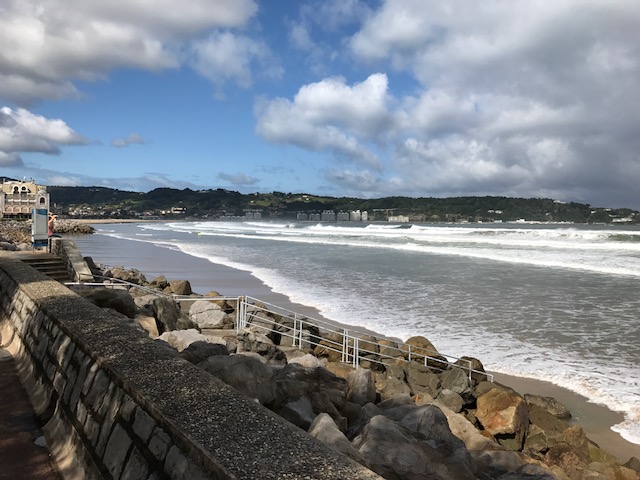
This has proved to be a confusing place, not only because of the Basque signage, but the layout and arrangement of roads - even the satnav has led us to flights of steps impassable for a car.  But today we went up along the coast back into France, to look for Ravel's birthplace - passing the surfing beach of Hendaye (OMG),


and to Ciboure to see his house, and on the bustling and pretty fishing port of St Jean de Luz.  The church of St John the Baptist is deceptive. Outside, it is modest enough, stone, plain, quiet. 


Inside, it has three tiers of dark wooden balconies with balusters each side of the nave, and round the organ at the west end. It has a massive altar-piece of course, but the whole thing is more or less exactly contemporary with St Paul's Cathedral in London and (like the buildings in Tenerife made at the same time) filled with details which late seventeenth century people would have welcomed as bang up to date. It is marvellous, worth coming for all on its own. It is theatrical, democratic, accommodating, wooden, huge and memorable.

This account is probably long enough - though I have missed out so much - the waterfalls, the castles, the massive mountain cliffs, the distant views, the delicious meals. It is very intense. Exhausting actually. I think this is my reaction to the crash... things are exhausting, because I am grabbing on everything. Apart from my wonderful pink hat, which I have only had for a week, and which I lost today. We went back to try to find it, in vain. It is gone and I am very sad.

Saturday, 9 September 2017

Rocks and mountains

The valley is formed from massive impressive glaciated mountains with almost edibly delicious swirls and stripes of different coloured rocks, towering cliffs and rounded peaks, terrifying drops and what seem to be totally inaccessible hanging valleys and forests high above. A national park was created back in 1918, and it's now part of the UNESCO world heritage conservation programme due to the precious diversity and pristine atmosphere.

You can see the Torla Fold on the left of this picture 
You are only allowed to get up to the park on a bus, and we (being old) had a price reduction for our tickets. There was a long queue to get onto a bus, and each bus has kennels underneath for lucky pooches being taken walkies in tham thar hills. (It does look a bit like a Western movie).

We did our five miles or so along a rough but well-maintained gravelly pathway - boulders, sand, rocks, some parts paved where mountain streams are likely to wash the road away, some very loose scree. How this path survives winter snows and melts is a question.
Parts of the path almost looked like somewhere in Surrey - till you look up and see the massive mountains above you, through the trees. Far, far above.  In the slightly misty air it was hard to estimate how far away they are, how tall.  In fact they are getting on for 3000m high.
It was really amazing the number of people and how old and how young they were, we saw on the path. The map says it's an hour to the first waterfall, but we found it was quite a lot longer than that, even going at a fair lick.   We saw lots of babies being carried back-pack style, tiny toddlers, slightly disgruntled young teens, masses of hefty keen walkers, many older or even elderly couples or groups.  The young couples ignored us.  The families were friendly.  It was the older people who were most likely to say 'Olá!' or give us some other greeting.   We estimated that even at this time of year there must be well over a thousand people trekking along to see the waterfalls every day, and we were on just one of many possible paths through the park. There are loos at the carpark area, but none along the route. So, occasionally, as on the famous St James camino pathways, you see scraps of tissue where people have ducked behind trees for a pee or more.  The climb (which is not just up but also down and up) is said to be about 100m altitude - but the waterfalls are beautiful, interesting and noisy. 
We had noticed that some areas of paving in Broto and Torla have strange undulated veins running over them, reminiscent of the blood vessels on the coats of some well-groomed horses, and I asked via Facebook what this effect is called. It led to an interesting debate, with one friend, Duncan Grant, promptly sending a reference to something called the Torla Fold (see left of photo above), which is a mighty toffee-like squidgey sandwich of rock stripes bending back on itself, which we could see from our lunchtime seats in an excellent tapas bar.  There were no clear answers about this paved surface, but it sent us out to do more research and we came to the conclusion that it's a natural effect of the solidified rock being laid down as mud (500 million years ago), possibly heated, with possible intrusions, some of which look like white marble, and some of which are these thready decorations.  Very handy as a foot surface in a place with such icy winters.


The hotels all close for 3 months a year, maybe the whole village shuts down. There's no ski-ing here.
Our final call of the day was to break into prison, the Torre de Carcel de Broto which I mentioned before. The gaoler is now a very pleasant housewife who lives just along the alley. The tower looks pretty much like an ordinary house. However, it has three floors. The lowest is a cellar or warehouse, now completely separate from the museum, accessed from the street below, further down the hill. The prison is a stone room about fifteen feet square, lit only by two miniscule squints to the west.  No facilities at all, walls all blackened and sooty, or just dirty.  The top chamber presumably belonged to the Magistrate, with a barrel-vaulted roof, a proper window space though no fireplace, and a magnificent, well-designed bog in the wall, complete with a cylindrical stone drop for his poo to go down through to some unknown heap somewhere below.  The whole message of this was, I suppose, to emphasise that prisoners had to live in their own squalor. The ongoing fight for use of the high mountain pastures was always going to be hazardous, with the risk of imprisonment in dungeons like this if you were caught by the other side.  The prison seems to have been in use for hundreds of years. The prisoners - some of them - artists and free spirits - spent their time carving holy graffiti into the blackened walls of their cell - saints, musicians, soldiers, a Calvary, geometric shapes, crosses, animals, lots of free-flying birds....  They must have used little shards of stone to while away their stinking hours, in the near pitch darkness, drawing images of radiant light and godliness.
Life in the mountains is always going to be tough, breeding tough people with a strong spiritual quality. They apparently need few 'things' to help them live in these vast stony valleys. Just their eyes.


Friday, 8 September 2017

Day three post crash

I have hesitated to resume the blog, for various reasons. I felt very trembly and weak, for one thing. And life, ordinary life, suddenly seemed a bit trivial after the eyeball-searing moment watching the huge camion bearing down onto our car.
However, things seem to be resuming more of an ordinary cast.
More than anything else I want to celebrate being alive!
We drove - the next day - and despite my sister's wish that we stay on longer, into Spain, through the Bielsa tunnel in the end.  Lunch en route at the Les Routiers in Masseube which was wonderful, well attended and we recommend it if you are passing.


The countryside in France is so completely ordered, buckled down, managed, signposted, controlled - and the minute you get into Spain not only does the sun come out of the mist, but everything relaxes. That in itself seemed an endorsement of joy.
It was a long day's drive and I noticed I did actually flinch each time a lorry came towards us, or too close, even though my husband (who I often call The Concierge but should in this instance have titled The Chauffeur) is a very safe (even boring) driver.
The mountains shouted their magnificence.
The road twisted and wound its way.
We saw vultures - griffon vultures? And an eagle.
We saw waterfalls.
Glory glory.
To think I might have missed all that.
Our hotel was Completo (but we had a room reserved). The room turned out to have its own sitting room attached, and a balcony, and stupendous views.  The price including parking and an excellebnt breakfast was €60 for the two of us. No wonder it was Completo.
We found a sort-of rough tapas bar for a light supper.... workmanlike would be the word.
I slept like a log, the minute my head hit the pillow I think. Exhausted (and no wonder, with all that flinching).
We spent the day visiting the area - two villages in particular - Broto a little further down the valley, and Fragen, smaller and hanging above Torla. Torla itself is the main jumping off place to go and visit the National Par of Ordesa, twenty minutes away by bus (no cars allowed).  The whole place closes down from November to March. One characteristic of this town is the sweet medieval double-arch stone windows set into the strong square stone walls.  
In neither Broto nor Fragen did we spot anything like these, though all three have wonderful columnar stone chimneys with decorations on top.  In Torla, some of the roofs have these knives or cutters which diminish the impact of snowslides (mini avalanches) by slicing the snow-mats into strips. The very old houses have stone slab roofs. The very new houses do not have these gadgets.


Broto was bombed to bits in the 1930s and has been well rebuilt with modern housing and hotels around its medieval centre, and it has a fantastically beautiful waterfall (cascada) about 5 minutes easy walk from the centre.
The main topic of history is the centuries of warfare with the French, disputing ownership of the high pastures.  Wherever we go, it's war, war, war.... until my lifetime (at least in my part of the world, Europe).
My golden life. Which I still have.
We moved to another hotel which had space, and we're here for 2 nights. Now we're off to the National Park, and later will try to get into the prison at Broto when it opens this evening to see the carved art on its walls, made by people travelling through, or incarcerated for squabbling with (killing?) the French, or the Spanish.


Tuesday, 5 September 2017

Crash

The lorry hit us very fast and very hard. I thought, 'We are going to die'. We spun round. The air turned brown.  We came to a stop. I thought, 'We are ok'.

The engine part of the car was smashed. The lorry came to a stop 100 metres down the road on its side. Everything was very quiet. No-one around.

I opened the car door, got out.  I thought, 'I hope we don't have fire!'

I thought, 'I don't know the right number to call for the police...'

Steam, white vapour came from what should have been the underside of the lorry.  My sister and her friend Kate were still in the car.  I didn't want to go to the lorry. I thought, 'I hope that guy is ok. There's no way I could get to him, or get him out.'


At last I saw a man from the garage on the corner coming out into the open. He was on the phone. He would be calling the emergency services.

I couldn't find my glasses - it's hard to use the phone without them as the text is too small. I couldn't remember my sister's home number by heart, wanted to call her house to summon her husband and mine.   I tried.  It rang and rang. After a long time, Chris answered. I told him about the crash. Told him where we were - the road numbers at the crossroads.

I talked to Sheila and Kate. Eventually they got out of the car too.

People started to appear.  This must have been ten minutes after the crash. I took a couple of photos - it was hard to know what to do, what I could add.  An emergency crew arrived, parked by the lorry which was slung right across the main road, a complete barrier.  The road remained barred, by the way, for several hours.

A car stopped - some other people who were heading to the same social meeting we had been going to. They said they'd send someone back to be with us, and pass on the info that we were all right.

Teams of ambulances, police, fire engines, SAMU, doctors arrived.  There were a very great number of them.  They kept asking us, name, age, date of birth, address.... all written on random pieces of paper. It took a while for them to sort us out. Three old English women, two living in the area, one from England.  Each service seemed to need the same information, kept asking us.  Maybe this is a way for them to establish who is or is not compos mentis.

Eventually, about fifty minutes after I'd rung, Andrew and Chris arrived. By then we were in our various ambulances, having blood pressure and questions and palpations done.  They kept us separate. Kate was breathalysed twice, and had her tongue scraped for drug evidence. They kept shutting the doors of my ambulance till I said I was a bit claustrophobic and needed them open - so I had a bit of light, and air.

Two fighter aircraft flew over, very loud and very low. Practice. It seemed like an underlining of some sort of message - that there are powerful forces way out of control, which can affect us at any moment.

The medics took us to Cahors hospital - quite a long way away. We went in convoy, one in each ambulance.  I was strapped down onto my trolley-bed like a parcel on the top of a bus... and I had to talk (in French) to the young guy whose job it was, presumably, to keep me awake. That was tiring. Dredging up the right vocabulary for all these things - it took about another hour.

Then more checks, everything calm, polite, efficient. It all stopped for lunch. Then Kate and I were told we were free to go, Sheila had to have some sort of scan as she may have damaged her spleen.  Chris and Andrew had had lunch while we were being seen, brought us some pretty awful sandwiches (yum yum) and took Kate and I home. Chris then set off again to collect Sheila.

The afternoon was warm enough. I sat behind the house to paint the landscape which I have painted many times before, with the tiny road rising up the hill and bending out of sight. It's fascinating and very difficult to capture.  Looking at the painting now I can see how swiftly I did it.


There was a lot of driving during the day - to Cahors and back. France is so beautiful. I was longing just to stop. To sit and do nothing. To contemplate the grass, the hills, the winding roads, the insects.  To ponder how it was that by one split second we had avoided instantaneous pulverisation and death.

Monday, 4 September 2017

The River Loire is familiar to us from numerous luminous paintings made by great artists, and since one of the purposes of this journey is to improve my own artistic style and standards, I had to try to make a record of it for myself. It is a strangely non-existent river, hidden in this central section by massive banks on either side, each carrying two-way traffic. The water lies low in the middle, fringed by shallow beaches, islands, shrubbery, and sands. What is compelling is the light which spreads over the whole broad scene, dragging your eye away and upwards, and into the past too, to imagine how this may have been in the old days, and whether Romans and dinosaurs saw much the same thing or not. I have not been able (in a very quick sweep) to find out what age these huge river banks are. They seem modern - post-war - and in some cases they rise up out of the surrounding marsh right up against the front doors of ancient cottages which are now either abandoned or have succumbed to the ignominy of having a mountain range within inches of their front windows. But from a seat on the southern bank I sat and sketched the river looking north, and then painted it.


Our home in Tours was - this time - a camping site near to the pretty and historic village of Montlouis-sur-Loire, and we had (thank goodness) reserved a tiny cabin or chalet. This is a white plastic box in a village of identical - larger or smaller versions - well supplied tiny homes. We lugged everything in, made the bed, went out to eat at the restaurant which had attracted us back to the area. Of course, as they say, you should never go back. The meal was fine, lovely cooking, but not as good as the one we had there in May. The outstanding exception was a starter chosen by Andrew - a parfait of creme fraiche, filled with a sorbet of tomatoes. Bliss.

It was warm enough for us to sit outside and eat, but during the night, the temperature plummeted - down to 10 or so. And in fact, on the Sunday night, it rained enough to fill the river right up to the top of its banks, or that is what it sounded like. Thank god we weren't in a tent.

On Sunday we explored the area - Montlouis - Amboise - the Chateau of Bordaisière with its rampant collection of tomatoes - and then went home to cook and do nothing.  I made my second round painting - trying to reach into more unconscious areas of my art. It should be called Brexit.


And on Monday, having watched the campsite management extract a family of tiny blue-eyed kittens from underneath the communal washing-up sinks, we set off to my sister's. The new motorways coming down past Limoges and the Dordogne take you through the most spectacular landscapes, and the late afternoon sunlight only filtered through occasionally, giving us a coolish grey day to drive in, which was a blessing.  It was also a blessing to turn away from the 21st century and onto the back roads past Molière and LaFrançaise, down to the Tarn and Garonne rivers, through tiny valleys, past a huge nuclear power station, past horticultural projects and small farms, with betrothal woods planted in the wet ground (perfectly aligned new groves of poplar trees which - when cut in 21 years - afford a good dowry to a daughter). 
Arriving here we swam in the pool, had supper, laughed, retired. Today we go to meet some of her friends and then have lunch. This is the International Ladies Group. Their menfolk have formed a subsidiary independent group called the Drivers and Affiliated Trades or something. They do their own thing but ferry the ladies to their lunches and back again. 

Sunday, 3 September 2017

Travelling, or just consuming?

At the entrance of the onboard shop on the cross-Channel ferry is a large cheerful and highly ambiguous sign saying 'Wave goodbye to high street prices'. Yes indeed. Here the sunglasses cost £200, and a vast array of perfumes and creams in different brands and boxes start at about £31. Whatever fun I used to get browsing such spaces has completely gone. The books and maps department has shrunk to a single shelf selling colouring-in books and comics, plus a couple of phrase books in German, French or Dutch. The entire experience is a rat trap, selling only things which maximise profit, and there is literally nothing on sale of any use, purpose, inspiration or longevity. It is all about addiction: alcohol, 'beauty', appearance. It is a shame. There's nothing wrong with making a profit, but somehow the customer, me, has been written out of the story. I am travelling to learn, change, grow, act. I do not want to feel dictated to, or passive, or merely a recipient of someone else's designs and theories. They have got this wrong.

Once again I get this big hit of 'change' the moment we get to France. It's just – French. The landscape, the tree-planting, the signage, the exasperation, all Gallic.


Through inattention we take a more circuitous route down to Tours than needs be, but find lovely Roman roads along the way, an industrial zone called Musset, a plastic chicken in a cage in a supermarket on the eggs shelf, and eventually our chalet on a campsite near the Loire. It is not a Tardis, being smaller inside than out, but it's comprehensively equipped and proves to be comfortable and fun. The bed takes up most of the space in the 'bedroom' which leads to hilarious edgings-round to get to the loo in the night. We had reserved a table at le Petit Patrimoine restaurant in town (and would not have got in otherwise) because we loved the meal we had there in May. This time it's slightly less successful (never go back) but still offers some superb cooking. The sauces are absolutely traditional reductions, and Andrew's first course – a parfait of crême fraiche with a tomato sorbet in the middle – is world-class. The meal was slightly marred by his anxiety at having mislaid his small wallet with money and cards in it.... We found it on the ground by the car when we got back to the chalet.


We have breakfasted on delicious croissants and a jam or marmalade of Oranges Amères, and today we will do very little. We are trying to have less oomphetty holidays and more wandering around time.