Thursday, 12 March 2020

Who invented steps?


We come to rely on systems, and then when they fail we go back into the old ways of doing things. Arriving here on Tuesday, my mobile phone wouldn’t connect properly - no mapping. So we used Andrew’s which was working ok in that respect although I am wretchedly unfamiliar with its controls and habits… Still it got us to our destinations, and meanwhile I started to look at the road map I had had to buy at the airport. Three euros.  (They give you a very good free one when you pick up your hire care in Ireland. Same company, different generosity).  This 3€ map is printed on glossy thin paper and after being opened and folded a few times started to give way on the folds, and a remarkable amount of information on it is printed in such minuscule font that you can barely see it. It’s so bad, it’s almost worth starting a collection of bad maps to show up its uselessness.  

Anyway, with a week in front of us and no particularly pressing priorities, I asked if we could call in to see two temple complexes not far from where we are staying: Skorba and Ta’ Hagrat. These lie off the road we had taken to get to Mellieha, so with Andrew’s phone and my silly map it was easy-peasy.   I should say, getting familiar with place-names is not so straightforward because they are mostly rather Arabic, though spelled in Roman alphabet.  We had just about picked up that ‘Triq’ = road, or street, and that’s all. 

We found Skorba really easily and wandered in, through an open wire gate, but a man in a shed said we needed tickets and sent us back to ‘the bar on the corner’. The bar (at 11am) was chockablock with local people, almost all of whom were eating huge meals - spaghetti, lasagne, stewed rabbit, vast hamburgers.  The owner was frantically serving coffee from a large urn at the back of the bar, which was heated with a blazing gas burner.  He shouted out ‘Tickets?’ to us in a cheerful voice and then told us to wait while he dished up more coffees to people clustered at the counter.  We ordered coffees too, and he gave us our tickets and we went back to the the temple. 


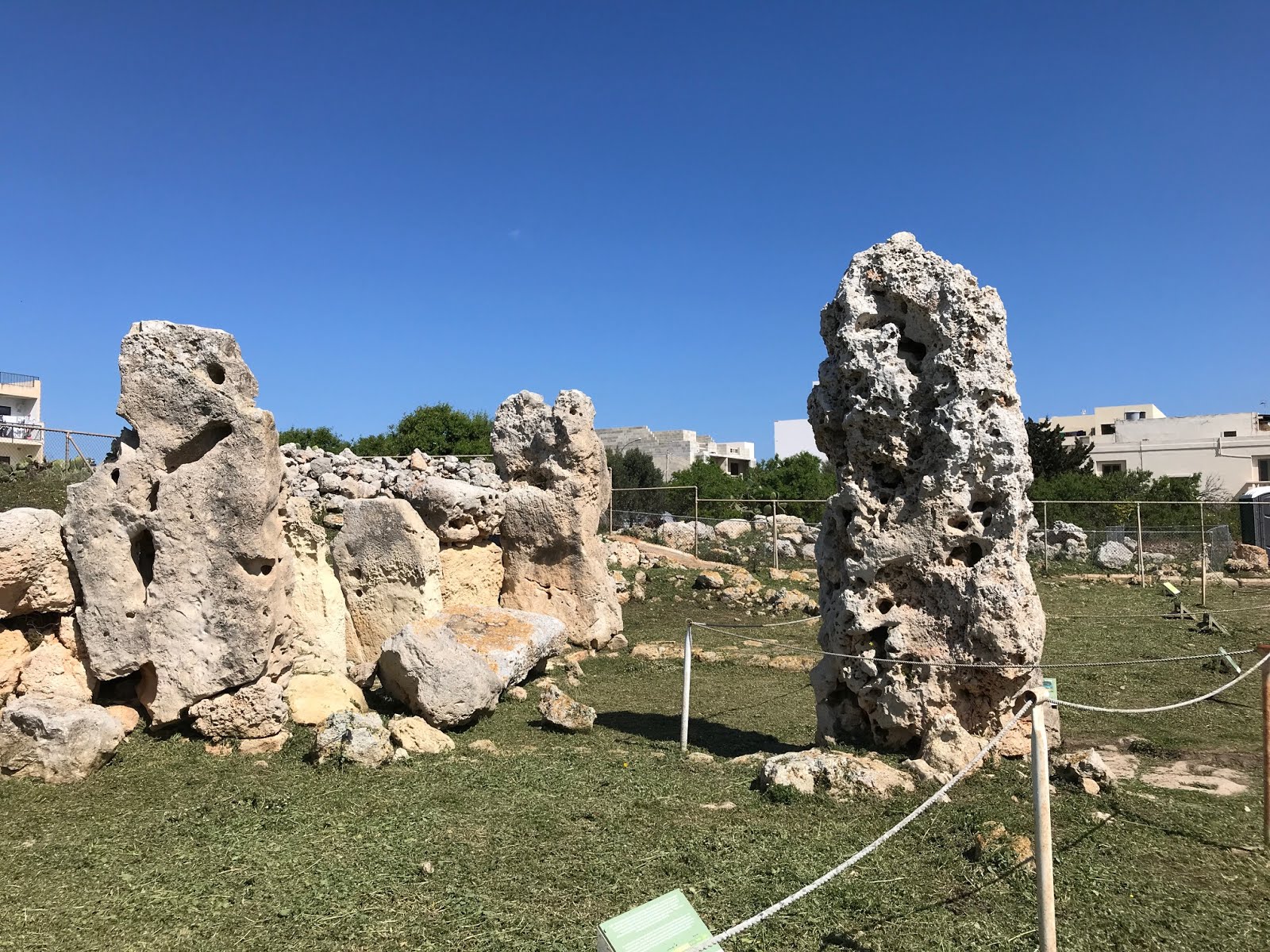
The site is a small area, fenced off, about the size of a tennis court, and filled with a jumble and cluster of rocks and boulders; some are standing. It was apparently only excavated in the 1960s, and so had the benefit of modern analysis for the finds - they had discovered carbon-dating by then, whereas most other sites had been dug into in the 1920s or earlier, and so those places remain mysterious in some (almost all) respects. Skorba provided more solid dating evidence, which illuminated the rest of the island’s treasures. The published dates on the information boards are contradictory and awkward, nonetheless.   What’s clear is that there was first some kind of settlement, then a ‘temple’ which had the now-familiar triple-chamber layout, and that was much later adapted and changed, and then - who knows?  Here they found a beautiful goddess figurine, with breasts and a pubic triangle. The man did not know where this is now - presumably in the National Museum.   He had cut the grass around the stones, and it lay withering in the sun.  

We went on to the next temple - Ta' Hagrat.  Again, a wire fence, a man in a hut. He was Russian.  He asked to see our tickets, wanted to know when and where we had bought them. On inspection it seemed our tickets were dated 5th December last year, and expired on 4th March but he let us in anyway.   We were the only people there.  He said, moodily, people complain the temple is very small.   Actually it is not small, though it is cramped by its modern boundaries, and is placed on the side of a valley with nice views. This site is about twice the size of Skorba.  Here again is a jumble of stones, hard to make out at first.  This was just a farmer’s field until 1916 - he had moved a couple of great stones out of the way, and the archaeologists put them back where they thought they should go in the 1920s….The caption says "They increased the verticality of the entrance". That's a strange expression. It 'might' have been very low, like the doorways in the Sardinian nuraghi, or the great mounds at Newgrange in Ireland. It’s hard to say if their reconstruction is right, and we will never know.
   

But - my goodness! Here is something!  What they made was a really large impressive doorway, approached by a flight of massive steps. These are thought to be the earliest steps found, or something.   Now, this is a bit of a thrill for me, because I do wonder who invented steps.  I asked on Facebook and Twitter last year, and no-one answered. I know, I know, this is one of those questions which everyone thinks is so bleeding obvious that it’s ridiculous… but like all useful things, steps had to start somewhere. Any rocky slope may have inspired the idea, but someone, at some point, got other people to lug blooming great rocks into place to  create an even and easy walkway up or down.  This little flight of stones at Ta’ Hagrat may be the first one, or one of the first.  No goddess figurine found here, but at Ta’ Hagrat they found a remarkable little model temple carved in stone.  These structures and artefacts have their origins about 5000BC… the late Stone Age. Thus, they predate the Copper Age and the Bronze Age, when tools were changed into weapons, and the goddess gave way to a series of increasingly violent and assertive egoistical gods.   I have to be very wary of leaping to these conclusions, and they are not really conclusions but questions.  The layout at Ta’ Hagrat is even more strikingly 3-chambered… once symmetrical, then altered with a different alignment so that the right-hand chamber was elongated and became the entrance for three more smaller chambers…  


This is all very reminiscent of the nuraghi in Sardinia - but there, of course, the entrances for these Stone Age structures are really small, vaginal.  And they (like the Newgrange mounds) have small window over the doors, to let the winter solstice sun into the interiors.   This great doorway at Hagrat is now utterly different - but it was made in the 1920s, so who knows what it was like originally?   The moody Russian in the hut did not know about the nuraghi, but was interested.  He too had cut the grass which was drying in the sun. But some spectacular wildflowers were sprouting up, as everywhere... so beautiful. 


We headed back north, to view the spectacularly beautiful bay at Ghajn Tuffieha, which has a Gaia Peace Grove at the top of the cliff (complete with graphic warning signs of how dangerous it is on the crumbling edge).     We walked down the long long flight of steps (renewed at the lower end) to the beach and had lunch in a pretty little terrace bar under the terrifying cliffs. The tables have rough patterns carved into them, so reminiscent of the Hooked Diamond shape I love (the ancient textile design which goes back to the Stone Age) that I took it to be a sign of encouragement from my Goddess .... and then I found more on some decorative treetrunk sculptures near the pay desk.... though these came from Bali and have absolutely no connection with Malta other than fashionable stylishness.....


So, eschewing the long flight of steps, we strolled back up the old pathway which is evidently a river in the wet season.  We then went in search of the famous cart-ruts at the top of the Dingli cliffs, which have mystified historians… again dating from the Stone Age, they are ground into a rocky surface and may have been made by wheeled vehicles near some quarries, but their pathways are pretty random. We found the main area, but did not find the ruts, which was intensely disappointing…. (will have to go back).  The rocky surface looks pretty organic to me, with variations of surface looking entirely natural (memories of O-Level Geography, limestone pavements).    At some point in the afternoon, my phone started providing mapping but neither that nor the failing folding 3€ map showed us where the ruts are.  All I have is a small photo in a guide book.  


We dawdled home, calling into various little shops - bought some broad beans - came home, flumped. 

Wednesday, 11 March 2020

Modern travel... changes. Flying to Malta

I remember “London Airport” (Heathrow) in the 1950s because my dad worked for BOAC, and occasionally we went there. It wasn’t huge. It seemed like what we used to call ‘an airfield’, something still relatable to the ancient land-use, to be measured in fields.  In fact the buildings and fencing are all still there, a remnant of planning and development from the mid-20th century, or even pre-war. The floor of the public reception area had some sort of wind-rose design in it, I think. 

Look at the airports now! Several of them round London, occupying vast spaces which were (within my memory) good farmland, covered now with rolling acres of scabby concrete, and the buildings go on and on and on. These buildings give me a kind of dread, as they are all about crowd control - with thick plateglass walls which allow you to see filades of other people trooping along in another direction from your own, or herded into patient groups. There are signs and ramps and escalators and lifts and corridors which stretch into the vanishing point.  To me, it all seems to be a preliminary for some kind of fascist operation. They could horde hundreds of thousands of us into these spaces, if they needed to imprison us. It’s ready waiting, the airport landscape, with fencing, drains, pens, spaces, even catering… and all conveniently placed sufficiently remotely from the centre of the city.  Now this idea is in my head, I can't expunge it.  Sorry.  


The process of flying has become one of enumeration - we are no longer people, individuals, but digits in the computer age. We are scanned, photographed, tagged, bundled up and dispatched along various routeways.    Yesterday, despite the anxieties and doubts generated by coronavirus (Should we be flying? Will I catch this plague on my journey? Will we get back?) it all went smoothly enough. We parked, we survived the astonishingly bitter cold wet wind attacking the carpark while we waited for the shuttle-bus to the terminus, we checked into our hotel, we woke up in time, we went through the screening and checked in, and we found an indifferent breakfast … all without a hitch. Strangely, we had to do that thing of taking out all liquids and putting them into tiny plastic bags beside our luggage to go through the scanning machines…  When we flew to Ireland just a month ago, that requirement was not in place. The make-up and toothpaste could stay inside the luggage.   Maybe the North and South Terminals at Gatwick have different procedures. Such ponderings are little diversions from the ghastliness of it all.

The flight was perfect. The announcements on board have changed slightly - you are not to move seats without permission as it might disturb the balance of the aircraft. We flew at 39,000 feet - I think that’s over 7 miles up!   Makes having a poo on the flight somehow even more miraculous. Seven miles!   It was almost as cold on arrival at Valletta as it had been leaving Gatwick… cloudy, stormy.  We queued to be allowed in (still in the Schengen EU line), we picked up the key for the hire car. That was a shortish stroll from the terminus, but not in the allocated bay. It turned out to be herded in by a great swathe of other hire cars, about 4 rows back. 
 
The hard-working car-hire lad had to move all these out of the way before we could get ours out, and he was preoccupied because somehow he had lost his mobile phone (work link), and someone had driven off with it…. He was agitated. But we agreed all the (many) bumps and dints in the edges of our Ford Ka, and set off.    

Here is Malta - the road from the airport past Valletta is like like some sort of urban nightmare - a winding tract of car showrooms, builders' yards, tumble-down masonry, greasy engineering plants, anonymous commercial buildings, minute survivors of ancient farmsteads with a few rows of potatoes or gnarled vines, beautiful chunky square-edged balustraded balconies, lovely bits of 18th and even 19th century buildings, views down past the sprawling city to the sea, and eventually some sense of the countryside.  We diverted into Rabat (whose meaning, in Arabic, is ‘suburb’), one of the many many hilltop settlements with spectacular churchy buildings at the very top, and fortifications guarding higgledy-piggledy lanes and alleys…. There we had lunch in a courtyard (Piazza della Chiesa Parrocchial) beside the museum celebrating the short stay on the island of St Paul, on his way to Rome and martyrdom.  Our lunch was absolutely perfect - a salad of pears and Italian cheese, and then seafood.  I managed a quick sketch.... 


Then on we went, towards the north, with some agriculture now more prevalent, across a lovely flat little valley full of horticultural farms, and up into Mellihia and our apartment. 

This is 4 years old, with a lift to our 3rd floor eyrie. We have 2, or even 3, flat roof terraces, with distant sea views, and a quiet stony urban outlook.  There is nothing green in sight anywhere (apart from really distant hilltops far away).


 We walked down into the old town…. narrow pavements, tat shops, nail bars, cafes, two grocery shops packed with everything including lots of fresh broad beans and other summery vegetables, and brands of (ie) jam which are no longer found in Britain (Foster Clark).  We were amused by the local car numberplates.  


We went into the two churches which are (according to a guide book) built ‘atop one another’ (eh?).    One is very old, built into a cave in the cliff and all squint… with an icon or mural of the Virgin Mary holding the infant Jesus. This is reputed to have been painted by St Luke himself in AD60.  I seriously doubt it.  The church is smallish, packed with votive junk and decorations and is really wonderful.  A nun is on watch.  


Outside, and on top of the cliff is an airy spacious baroque ‘parish church’ (cathedral sized), with a lovely white stone interior and red stone outside. The statuary adorning the inside of the dome is risible. 

Thursday, 6 February 2020

Airports


Airlines have to treat you as a special individual when they’re encouraging you to book your seats. 

But the minute you get to the airport you are one of 30 million others. You are no longer a potential customer, but just a small parcel in the constant flow of objects through these depressing and hard-working buildings. 

So how they treat you is quite different.

In fact the technology has moved on huge amount. 

You no longer have to pull things out of your suitcase to go through the security scanners. Something about what I was wearing made the X-ray archway beep so they searched me. The woman said 'What have you got in your back pocket?' I produced a small piece of tissue paper that I had with me. 

The scanner could detect a piece of tissue paper - right through my body.

Then in the loo I was glad to see that the sanitary-towel disposal system has been improved. It’s now a small black tower with a dome top. It stands in the corner behind the pan, right out of the way. To open it you wave your hand over the top of the dome, which slowly rises, leaving an aperture for you to deposit whatever it is you want to leave there.  You don’t have to touch anything to open it.

However the hand-washing facilities leave something to be desired. The water comes dosed with soap, and the dryers (one per basin) don’t work. So you walk away from the loo with sticky fingers, still wet.


Tuesday, 24 December 2019

Two ruined places... how rich the churches were


We came to Kilkenny via Wales ready for Christmas.  And we've visited Lamphey and Kells, two quite different church sites, both ruined, and different in so many ways, but provoking some ideas about how the rich spend their money and use their power.....

In Lamphey in Pembrokeshire you can visit the ruins of a once-gorgeous Bishop’s Palace. Created in the early 14th century by Henry de Gower (whose name indicates Norman origins nearly 300 years after the Conquest) who was Bishop at the cathedral of St David’s, not far away. Lamphey Palace or Court had rich and splendid buildings - a chapel and gatehouse of course, a wide perimeter wall, a huge barn for storing grain, and a hall with a truly show-off roof, having an arcaded parapet where guests could walk around and view the lovely valley. This parapet rising above the clerestory of arched windows lighting the hall beneath, is still there. 


There are outbuildings, cellars, towers, gates and stairways, in surprisingly good repair. They had kitchen gardens, herb gardens, orchards and a deer park, so food was never going to be a problem. The bishop’s place of retreat was sited - like the cathedral - beside a useful working stream, so they had a watermill to grind grain, and the buildings were so fine and true they have survived centuries of ruination and despoliation. After the dissolution of the monasteries it was sold on, and eventually descended into use as a farmhouse. It remains as a tidily-kept and rather theatrical monument, like a stage-set, waiting for something to happen.


Across the water in Ireland we went to visit another ruined place, the Priory of Kells near Kilkenny. This is not the famous Kells Abbey, home of that radiant Book which now lives in the Library at Trinity College, Dublin, but an Augustinian house, built by Cornish monks in the twelfth century.   Thus it predates Lamphey by about 140 years, and was not a pleasure palace but a monastery. The oddity of this place is its high standard of fortification.  The founder was called Geoffrey Fitzrobert de Monte Marisco - whose name also reveals his aristocratic/Normal status - in fact he was an Anglo-Norman knight.  There had been an earlier, pre-Norman church there, dedicated to an Irish saint, Kieran, but the new stone priory was dedicated to the Virgin Mary.   

Here the remaining ruins look slightly less steady than those at Lamphey, and some are propped up with new buttresses, but they are utterly magnificent.  There are many towers - clearly defensive. The nave, transept, cloister, the footings of many rooms and outbuildings all remain, like a labyrinth.  The children running round with us stayed close, as it would be easy to get lost.  At the back, there is of course a river racing through, known as the Kings River, and with an island and bridge - so here, too, there was a watermill.  All these great houses had mills as a means of sustenance, and of taxation, as they could charge the peasants to grind their corn into flour.  The ecclesiastical magnificence cannot be denied. It was a splendid place… and later attracted predatory attacks, because in due course the monks felt they had to build a huge curtain wall on the uphill side of their priory - with six towers complete with arrow slits and garderobes. Here they could graze their beasts more safely. And it made the whole place look like a military outpost rather than a house of prayer. Even today as you walk down from the road you see first of all this huge wall, with its spy-holes and slits, and you know the men inside were feeling defensive…. 


What struck me about these two ruined and more or less empty places was how expensive they were, how lavishly furnished according to their times, with carvings, huge windows, high walls and splendid adornments. Their builders - both scions of the Norman-French conquerors who in the turn of one single day in 1066 took the whole Anglo-Saxon kingdom (which I suppose then included Ireland) as their playground - used their power and wealth to build the pleasure-palace and the priory without a care in the world, or so it seems to me now.  They chose plum sites, summoned their workforces, consulted the best architects, and set to work. Hundreds of years later we can admire what they did... how spectacularly they lived, how they could display all this to their friends. They lived like lords, which is what they were despite their church status. 


And today, after the stunning victory of the bankers’ men in Westminster, and the alienation of so many people who fought for Britain to stay as part of Europe and for the real survival of our NHS, these two places have for me a sinister message.  They show that the rich and mighty like to impose their wishes because they can, and their desire for comfortable survival over all the others, heedless of the pains of the poor, can all too easily be put into practice. 

Monday, 14 October 2019

Ice cream

I meant to say, while we were in Sardinia, that it's deeply disappointing to find how much 'ice cream' has changed, even in Italian territory.  As with bread, the memories of what we could buy when I was a child are clearly irretrievable.

Italian ice-cream was world famous for its rich fruit content, bright colours, delicious taste and loyalty to an old tradition... there's even a music-hall song about an Italian ice-cream seller. They knew what they were doing.  There was an family-run ice-cream business in Chalk Farm, a mile or so down the road from where we lived, and sometimes an uncle or somebody would go down there to bring some home - wrapped (weirdly to me then) in a towel to stop it from melting.

Image by Toddot
It was different from the Walls ice-cream otherwise available in shops, which came as Vanilla, Vanilla-Strawberry-Chocolate, or Neapolitan which had a strange green stripe in it.  Marine Ices ice-cream had a zing and punch of taste which was just worlds away.

What we've noticed in travels in France, Spain, Corsica, the Canaries, Madeira and now Sardinia is that 'something' has happened to ice-cream.  The shops are glamorous, with glass-fronted covers over displays of several steel dishes of luridly coloured product.  The names are the same - the Stracciatella, the Pistachio, the Doppo Cioccolata, the Fragola.... but the flavours and content have gone. The texture is always the same - smooth, with no crystals, consistent.

I imagine that scientists have got their hands on it, to maintain the texture. Its propped up by glycerine or somesuch. So these packs of product, on display, in varying temperatures, exposed to light and air, have to stay looking attractive... The 'look' has become more important than the taste, because that's what leads to the buying decision. Customers are unlikely to come back anyway, as they are wandering around on holiday. The colours, the choice, the names of the varieties are what drives the sale.  The first few seconds, when customers stand in the shop for the first delicious lick - well, the taste will be good-enough for that, and the texture will be pleasing at that moment... 

 But when you have (over a period of time) tried several ice-creams, and found they all have exactly the same texture, and the taste is always slightly disappointing, then you have to concede that things have changed - for the worse.  No granules of ice, but no real high.  I don't know if it's glycerine, but it's something creating this texture.  And I think the flavours have been industrialised too, based on syrups instead of real fruits.  So, if you want real old-fashioned proper ice-cream, you will either have to find an artisan maker on your travels, or make it yourself.

Monday, 7 October 2019

Rainy Ireland


Here we are in Kilkenny, where it’s pretty cool, grey, and wet. Such a contrast with the heat and scorched browns and golds of the Sardinian lands. We flew in to Cork on the day that Hurricane Lorenzo crossed over Ireland, but everything stayed on schedule. The only real signs of the storm that we saw were great flocks of rooks up in the air, apparently surfing and playing in the wind. There were hundreds, maybe thousands of them altogether.


There’s something about all the birds of the crow family - their power, intelligence and beauty. Though, this morning, I read about a mob of magpies flocking together - nine of them - to kill a hare.  The hares are wondrous in their own right, demanding a special sort of attention. You don’t forget it if you see one.  

We are in a quandary (like millions of others, of course)….what to do if Brexit goes ahead? We have these two delightful little grandsons growing up in Ireland and we only get to see the about 5 or 6 times a year. Maybe we should leave England and come and live here? 

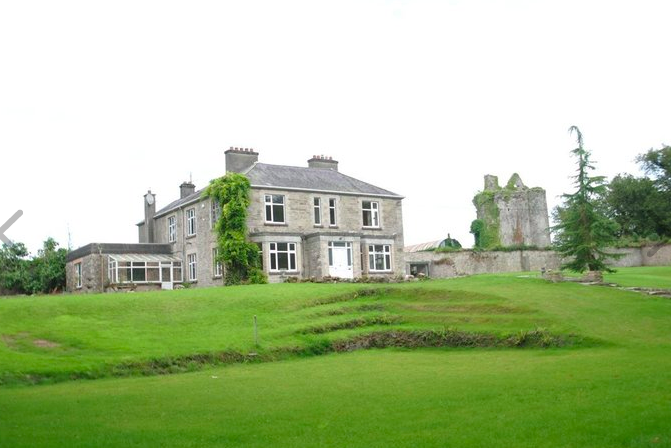
Faversham has its own problems - mostly do with suburban expansions around the town, undersupplied with services on the new estates and therefore inevitably bound to add to the traffic and parking problems in the narrow medieval streets, which are already difficult at times of day.  And the traffic in Kent will get worse, whether or not Brexit goes ahead. We frequently find the town has come to a standstill because of some road accident maybe 10 miles away, where everything has backed up.   So - much as we have loved living there, we are wondering if it’s time to move on. After all, most of the time, there are just the two of us (+ our lodger) rattling around in our rambly old house. So we did a bit of online house-hunting yesterday, and found a huge old place in the bog with a ruined castle in the garden….. 


Just my sort of thing, but it won’t happen. My dream would be for some sort of arts centre, or retreat, to help it pay its way.  Sigh!

We all wait to see what will happen at the end of this month. The ‘news’ and the politics of the last three years has been almost completely unbelievable - like some sort of mad melodrama, and we feel as if we’re watching the destruction of great chunks of our civilisation, and for what? To make a few billionaires richer?  No doubt the old smug post-colonial Little Britain attitudes needed to be challenged, but so far they seem to be in the ascendant - there’s a kind of myth propagated that that is the will of the people. It isn’t.  Coming away, to Sardinia and Ireland, and before that to France and Denmark, in the last few weeks has been a relief.  We have to go back to it all tomorrow.  


Tuesday, 1 October 2019

Buying honey


Some final thoughts on leaving Sardinia. It would obviously be a very nice place to live if we were to leave Britain, and didn’t have family ties in (e.g.) Ireland. It’s sunny, with a wonderful landscape and interesting history, etc. 

The obvious comparison would be Corsica which we went to last year. That is also very Italian but nominally or officially  French. I think on the basis of these two very short visits, I would choose Corsica at the moment, mostly because my French is better than my Italian. 

Still, as ever, here on holiday, we have been uplifted by all the human contacts we’ve made. Last night, we went to the local supermarket to buy honey to take home, and two women joined in with great encouragement to help us choose which variety, explaining which parts of the body would benefit from which kind of flower the bees had eaten.  This for the chest! This for the throat!  When we explained this was for presents to take back, they relaxed - smiled - said they’d all be fine!  It was funny and kind of them.  

Our walk round the back streets as dusk fell was very gentle. The light and the twilight were soft and the air was warm. The old streets with the few remaining ruins of old family farms are steep and clean. New buildings - villas, flats, holiday apartments - stand very firm and square with their concrete footings, whereas the old buildings made of rubble stone have less resilience.  We’ve had a great holiday. Home today.