The trains are delectable. Set on wide tracks, they are smooth-running, quiet, fast, clean, and even when crowded they have enough space to keep you relaxed. The carriages are designated for (eg) bikes, dogs, quiet zones, etc. the doors are prefaced with steps which do actually make it easier to step in or out, unlike our scary/irritating trains at home which are awkward at best and frightening at worst – especially for anyone with sight or movement difficulties. Tickets are bought from 7-11 shops which operate at every station we have so far seen.
We breakfasted at our little gite in the garden in bright warm sunshine, sitting at a large circular concrete table to eat our muesli and orange-flavoured yoghurt. Andrew picked this up from the store thinking it was fruit juice. Oranges are called Appelsin, which is confusing. Our breakfast was attended by sparrows – they are numerous along the beach due to the numbers of pizzas eaten by the happy gangs of teenagers who cavort and splosh and play in the waters. They have had a cold summer so far – this warm spell has come late, and the young are making the most of it, as are the sparrows.
I made a little painting of the fig and vine growing in ‘our’ conservatory – v pleased w the work, and only later realising I’d worked on the back of a drawing of Derek Steele’s Jack Russell Hans. Bah!
Then we caught the train to Helsingør, the Elsinore of Hamlet, ferry-port to Sweden at this pinch-point of the two coastlines…. The ferries run every 15 minutes to Swedish Elsingborg, and the journey takes about 20 minutes – a big watery competitive efficient bus service. Our bit of ocean is the most easterly of three outflows (rivers?) leaving the Baltic towards the North Sea. They are sea-swarmed rivers in effect – maybe the water is slightly less salty than the seas further north. The tides are minimal here - a metre at most. When the Vikings first spilled out from this region they knew nothing of tides, which came as a great surprise and mystery. Those three waterways are represented in the ancient logo of Royal Copenhagen porcelain – three squiggly lines. The two further west are entirely inside Denmark; this easterly one has an international boundary along the middle.
Helsingør station is worth a few moments of anyone’s time to take a squint at: high coffered ceiling in the main central hall, multi-coloured marble stairway, panelled walls, all reminiscent of royal apartments, and (although referring back to some splendid late-medieval era which perhaps never existed) it’s a full-on, plumptious late 19th century bit of swank. Shakespeare has proved to be a good friend of this bit of Denmark. Gorgeous.
Outside, the light is shimmering, the old dock spaces cleared away, the rival ferry services side by side just across the road, the tourist office near to hand, the medieval town hunkered down behind you, the Mariekirk - with Buxtehude memorial and fine organ case two minutes away, all of red brick, and complete with cloister, dating from 1540 in its origins, Carmelite then and now solidly Danish, with a patch of history as a haven for the halt and lame about 200 years ago.
Round to the old dockyards, with the Kronborg (Hamlet’s castle now covered in twiddles and dormers, and set into a Vauban-style fortification of zigzag brickwork) just over there. Some old 1930s dock-buildings have been done up. Here is a cultural centre – which won the accolade of Best Library in Europe this year. And here are some cafes and a theatre settled behind a remarkable glass zigzag wall, disguising the workaday offices behind it. Here are some elegant snub-ended docks with historic vessels moored up. And here, set into a huge sunken, stone-and-concrete dry dock is a brand-new subterranean museum of seafaring, approached down a gentle steel ramp, and leading through a brilliantly designed history of sailors and the sea. Children, mariners, travellers, historians, artists, film-makers, boat-builders, costume-makers, writers, navigators, everyone would find things here to amuse and enlighten them. Among the dozens of beautifully displayed artefacts I liked very much those model ships whose namesakes were lost at sea during WWII – they are shown in a near-vertical position, perfect in every detail, lit as they spiral downwards to the bottom in eerie greenish light, heading for eternity in the deep. Very moving. The story comes along to the present day with the arrival of those huge container shops which trudge around the world full of modern necessities (junk, mostly, no?). The models of all the boats are mounted in glass cases, and the bottom sections of the displays show the typical cargoes – coal, suitcases for passenger ships, grain, tyres, trainers. The very last section is dedicated to modern-day sailors, both sexes, who are mostly young and cheerful, and explain that when they’re at sea, they long to be at home, and vice versa. They all know how dangerous the sea is, but they love it. ‘It’s addictive’, says one.
We lunched in a tiny courtyard garden of an Italian café (blessed salad), did a bit of shopping, then took the ferry ….
My first visit to Sweden was very pleasant, and lasted 2 hours. It’s remarkable how different it is – signage, sounds, what people look like, all the little cultural aspects.
The main reason for this prosperous ferry is the tax-differential on alcohol. Our journey to Sweden was crammed with Swedes towing huge trolling full of booze, like the Brits at Calais.
Our boat was called Hamlet. These are about one fifth the size of our Dover/Calais ferries but otherwise equipped just the same. The captain’s announcements are very funny – you can only buy alcohol in Danish waters. And you can only buy tobacco in Swedish waters – the border being halfway across on this minuscule voyage. His pronunciation of the words ‘only’ and ‘hope’ are marvellously antiquated and hilarious – something like ‘hape’ and ‘anely’. The crossings are neat and swift. We bought an ice-cream, called Glass.
We came home on that reassuring train, showered and rested, and I made another painting in this pretty Japanese garden. Bente’s sister Klar came to collect us, and we walked along the beach to their soon-to-be-sold house, for supper and laughs, and a huge storm came up from the south. We ran home as the first great blobs of water hit the still-warm pavements, and fell into bed as the rains hit the glass ceiling of our little quarters.
Wednesday, 5 August 2015

Monday, 3 August 2015
Denmark
Denmark – staying a few days with Chris & Bente. Slept last night at the airport hotel, flew smoothly enough out along the Thames estuary, landed in sunshine and calm into a bubbly sort of peaceful chaos… Noticeably more immigrant families around than the last time we were here, a quartet of handsome young East African lads with cockney accents and good behaviour, signage rather poor (where to board your flight, how to get to the trains….)
Last time we were here, the railway station looked to us very modern and well-designed. This time, 13? years on, a lot of our own stations look the same, but still their trains are better, wider, quieter, smoother, more comfortable.
At Espergaerde we waited for our host who arrived in his tiny car a bit late and without explanation. The house is not far away….
In brilliant sunshine and astonishing clear light powering up from the sea, the little deco and modern house is radiant beside the sparkling water, pink and soft cedar-wood grey.
We sat, they made lunch, we ate a wonderful copious picnic of ingredients – a particular salami, some soft roast pork, duck fat instead of butter, finely sliced red onion, sweet long ‘asparagus’ potatoes, mayonnaise, cheeses.
Then Bente and I swam in the sea… Gingerly we stepped from the hot air, over the gritty stones and through the stringy weed into the cold clear water. This was me, aunt Bente and her friend Bente…. And the swim was wonderful in safe shallow water, with sailing boats and cargo ships zipping past somewhere towards Sweden a few miles away. Tycho Brahe’s Island is just over there. Friend Bente’s husband Fleming was not swimming but doing the garden, because he loves doing it.
Then aunt Bente walked us to our lodgings – although they have stayed with us many times, their house really is too smal for guests.
Along the beach is a sequence of grassy wild public fieldlets, with the beach full of families and sploshing children, and a marvellous little harbour filled with modern boats and some traditional ones – called Smakkeriggert… not so different from Whitstable smacks, either.
Our lodgings are in the garden of another beach house – the land covered in shingle with (7 tons of) granite stepping stones, and Japanese topiary, and sitting places with (eg) thick circular concrete table, and a sturdy grape-house just for our use with a fig tree trained into a ropey loop….. Our little room is all blue and white, with art on the walls, and a shared kitchen and bathroom – alas, in this trip, and for the first time ever, I emptied out my washbag of all shampoos, conditioners , etc at home, thinking that Chris and Bente would have everything and we are carrying hand luggage only. But we are undone, as the lodgings has nothing….
We had ice-cream, a walk, then back to the beautiful little B&B,and I slept!!!!
Now back at their jewel of a house for supper.
Last time we were here, the railway station looked to us very modern and well-designed. This time, 13? years on, a lot of our own stations look the same, but still their trains are better, wider, quieter, smoother, more comfortable.
At Espergaerde we waited for our host who arrived in his tiny car a bit late and without explanation. The house is not far away….
In brilliant sunshine and astonishing clear light powering up from the sea, the little deco and modern house is radiant beside the sparkling water, pink and soft cedar-wood grey.
We sat, they made lunch, we ate a wonderful copious picnic of ingredients – a particular salami, some soft roast pork, duck fat instead of butter, finely sliced red onion, sweet long ‘asparagus’ potatoes, mayonnaise, cheeses.
Then Bente and I swam in the sea… Gingerly we stepped from the hot air, over the gritty stones and through the stringy weed into the cold clear water. This was me, aunt Bente and her friend Bente…. And the swim was wonderful in safe shallow water, with sailing boats and cargo ships zipping past somewhere towards Sweden a few miles away. Tycho Brahe’s Island is just over there. Friend Bente’s husband Fleming was not swimming but doing the garden, because he loves doing it.
Then aunt Bente walked us to our lodgings – although they have stayed with us many times, their house really is too smal for guests.
Along the beach is a sequence of grassy wild public fieldlets, with the beach full of families and sploshing children, and a marvellous little harbour filled with modern boats and some traditional ones – called Smakkeriggert… not so different from Whitstable smacks, either.
Our lodgings are in the garden of another beach house – the land covered in shingle with (7 tons of) granite stepping stones, and Japanese topiary, and sitting places with (eg) thick circular concrete table, and a sturdy grape-house just for our use with a fig tree trained into a ropey loop….. Our little room is all blue and white, with art on the walls, and a shared kitchen and bathroom – alas, in this trip, and for the first time ever, I emptied out my washbag of all shampoos, conditioners , etc at home, thinking that Chris and Bente would have everything and we are carrying hand luggage only. But we are undone, as the lodgings has nothing….
We had ice-cream, a walk, then back to the beautiful little B&B,and I slept!!!!
Now back at their jewel of a house for supper.
Saturday, 25 July 2015
Why I won't join the National Trust
I used to live and work in Norfolk, long ago. Revelled in the beauty of its landscape and skies, the rich glories of the dialect ('mardling'), the large numbers of neglected cottages and barns, the clean air, the extremes of winter and summer, the haunted emptiness of the roads and fields. From time to time, warplanes of terrifying size and speed would split the skies in half, creating a rolling thunderous earthquake of sound, drumming out the story of our defence, our history, our ambitions and collaborations as a nation. I loved it - but work and marriage took me back south, and now I only come back for short visits.
Of course, everything has changed. It is still glorious, a head-long romance of a place, with huge golden fields, empty roads and lanes, langorous rivers, vast aristocratic stately homes, crumbling castles and neat villages. But the dialect is less often to be found. The buses are all privatised. The villages have bypasses and the spaces all around are 'developed'. Grumble grumble. I wish I had known I was living in history when I was here. I would have taken more careful note.
We went on Thursday to Felbrigg which although in the care of the National Trust is still full of the furniture which belongs to the house. The grounds are minimally kept - grass, a maze, gravel, empty paths, a bit of lavender round the footings. The house has a suite of rooms of the highest swank, imported from Italy etc in the 18th C, carved and gilded, pictures and frames to die for... almost unbelievable wealth. But it all dribbled down to not much in the end, with the 'Squire' who died in 1969 unmarried having run the estate himself from a charming little office in the basement, beside the Servants' Hall and the Workshop. His stable had stalls for just 4 horses that I could see. We heard two children playing a few notes on the Bechstein piano in one of the formal rooms. The big brother said solemnly to his little sister 'This is one of those old instruments. It has a lot of old tunes in it.'
The walled garden (4 acres?), was full of volunteer gardeners dead-heading about 500 yards of pinks. The echiums were 10' tall. The pomegranate tree was full of fruit. Substantial parts of the garden are leased out to local allotment-holders, who have to label themselves as well as their produce, it seems. The labelling is very good - short flat white sticks with black writing on them. Every kind of herb you can think of (but no Summer Savoury that I could see). Bantams make dust baths. It's all pretty idyllic.
We went on to lunch at the Gunton Arms - where co-owner Stuart the chef was cooking a non-stop series of steaks etc on an open wood fire. His business partner is an art-dealer, so there is plenty of modern trinketry - Emin neons, Hirst spots, etc. The fossilised elk-horns over the steak-barbie fireplace are already much more long-lived and better works of art.
Cromer Pier was lovely - fringed with children fishing for crabs, children eating ice-creams, children eating burgers and pop-corn, children roller-skating, children in sunglasses. The lifeboat station at the end offers you a free visit and all the time, you can hear people chinking cash into the donation boxes. The roll-call of rescues is fascinating, the boats and lives saved. No mention of failures. There were times when the lifeboat saved 30 or more lives, during the war 110 one night. The present Cromer lifeboat is called Lester and you would be very pleased indeed to see it coming to rescue you if you were in difficulties.
On the way back home, we diverted to find Baconsthorpe Castle - a marvellous open-air relic of a once-prosperous and ambitious medieval merchant family - who wangled their way through the Hundred Years War and the Wars of the Roses and finally achieved this huge and beautiful crenellated establishment complete with wool workshops and fulling mills - applying to have it fortified in the 1560s - ah, with towers and cupolas, and a moat! - but within 50 years their descendants had frittered it all away. It passed through various hands, someone lived in the gatehouse till one of the towers fell down in 1921, and now it's mostly grass and stone, and empty, like a bit of a husk, in the middle of nowhere. Run by English Heritage, as it happens. No bother at all. Good interpretation boards too.
On Friday (yesterday) the rains of god came down onto Norfolk - drenching, torrential, unremitting and so we crept across the county from one hospitable household to the second, and we are now in West Norfolk. Today we went to the Gatehouse of Pentney Abbey, the Narborough Museum, lunch at the Bedingfield Arms, and then to Oxburgh Hall. Tonight it will be into Kings Lynn for a concert by Freddy Kempf.
Pentney Abbey Gatehouse was bought by Howard Barton, a pilot, when (judging by the photos) it looked pretty much like Baconsthorpe Castle - just a useless mass of old flint and stone. Anyway, it was good enough to inspire him and he's done it up with the help of English Heritage and very nice it is too, though not apparently open to the public. We were lucky to get in, due to our hosts ringing and asking if we could visit. We were given a tour - shown how a rack-and-ruin became a shining star again, complete with inner steel staircase not relying on any part of the old structure, new roof, new walls, new crenellations. It is utterly gorgeous, and now just waiting for someone to come and put the vaulting back. It seems to have been built at the time of the Black Death, no expense spared, and maybe to have taken its income from a tollbridge across the River Nar (the main route from the Fens to the north coast of Norfolk). The rest of the abbey has more or less disappeared. The Bartons have a small discreet caravan site there, so you can go and stay and ponder.
Narborough Museum is in the old Methodist (Wesleyan) chapel, the brainchild of David Turner who (like Howard Barton) made a rendezvous with us to open up and show us round. It is a gem, a treasure house of mammoths and ammonites, maps, a model of the village as it used to be, history of the almost-forgotten Narborough Aerodrome, and lots about the project to restore the local bone mill. This vast sprawl of industrial buildings used to pound bones into fertiliser, and imported the bones from all around - including Germany. All was well till one day a human skull was found in amongst the German bones. This macabre find seems to tally with the life of the late Andrew Fountaine who lived across the road in Narford Hall. I met him once or twice when I lived at Red Lodge, a farm on his estate. He was keen on the Nazis and held camps, and practiced a fair amount of Seig Heils. Slightly more in his favour is how much he loved trees - planted thousands of them, and explained to me once how you have to intersperse your young oaks with faster-growing conifers which force the hard wood to grow straight up.
Lunch was in pretty Bedingfield Arms, beside Oxburgh Church - where the nave is completely roofless and open, but the chancel in full working order, complete with many a Bedingfield monument, despite the Bedingfields having been devout Catholics all through time. One of the main attractions of Oxburgh Hall is the picturesque Moat, and of course the Priests' Hole where the Bedingfield family hid their priests in times of trouble. The whole place is one of those wonderful/exasperating National Trust places - with a sort of sanctimonious, this-is-how-we-do-it air wherever you look. It's probably down to costs... they sell the same plants and the same knick-knacks in every NT shop (with the exception of some Norfolk glass in this one), and they have the same elderly and enthusiastic volunteer guides in each room (and some of them at Oxburgh are absolutely fantastic, thank you!), and they all seem to have a second-hand bookshop near the gate, and the same sort of smell wherever you go.
I was given a severe ticking-off at the entrance because I declined to pay EXTRA to sign their Gift Aid form... I was told 'We make people ASK for the non-Gift Aid tickets.' The woman was rude and bullying, and I was inclined to write and tell the NT about her, but this will do well enough. Her appalling manners were alleviated by the two sterling guides we liked inside (the man in the dining room, and the lady in the King's Room), and also, in fact by the two charming Entrance Volunteers we once met at Rudyard Kipling's house Batemans, down south. The main problem is that the National Trust has slid down into a corporate style and uniformity, and although we have paid to 'belong' in the past, every time I go into one of their properties, I think I will never join again and just busk it, one property at a time, even if it costs more.
The Priests' Hole is a very tight squeeze and it must have been very unpleasant to have to hide in there, but an attractive proposition if the Queen's men were after you because you still cleaved to the old religion. As a nation, there's a lot of blether talked about 'Good Queen Bess' and the Age of the Tudors/Shakespeare etc etc., but it must have been a nightmare to live through it, much like the fundamentalism of ISIS or Al-Qaeda or any of those other belief-based civil wars.... We went at it, one way or the other, after the Black Death put paid to feudalism, for two or three hundred years all based on which form of 'Christianity' you followed. Torture, war, inquisition, terror, savage punishments, racking, being hacked to bits, hung in chains, beheadings, mutilation, flung into a pit and abandoned, burnt alive in bonfires, being hung, drawn and quartered... (could anything much be worse?)... and that was all available at any moment to any Englishman or woman or child who found themselves 'on the wrong side'.
So all this 'national trust' stuff is too sweet and sugary for my liking. And Abbey Gatehouses too, however quaint and interesting, offer a smiling face, hiding a terrifying truth.
Of course, everything has changed. It is still glorious, a head-long romance of a place, with huge golden fields, empty roads and lanes, langorous rivers, vast aristocratic stately homes, crumbling castles and neat villages. But the dialect is less often to be found. The buses are all privatised. The villages have bypasses and the spaces all around are 'developed'. Grumble grumble. I wish I had known I was living in history when I was here. I would have taken more careful note.
We went on Thursday to Felbrigg which although in the care of the National Trust is still full of the furniture which belongs to the house. The grounds are minimally kept - grass, a maze, gravel, empty paths, a bit of lavender round the footings. The house has a suite of rooms of the highest swank, imported from Italy etc in the 18th C, carved and gilded, pictures and frames to die for... almost unbelievable wealth. But it all dribbled down to not much in the end, with the 'Squire' who died in 1969 unmarried having run the estate himself from a charming little office in the basement, beside the Servants' Hall and the Workshop. His stable had stalls for just 4 horses that I could see. We heard two children playing a few notes on the Bechstein piano in one of the formal rooms. The big brother said solemnly to his little sister 'This is one of those old instruments. It has a lot of old tunes in it.'
The walled garden (4 acres?), was full of volunteer gardeners dead-heading about 500 yards of pinks. The echiums were 10' tall. The pomegranate tree was full of fruit. Substantial parts of the garden are leased out to local allotment-holders, who have to label themselves as well as their produce, it seems. The labelling is very good - short flat white sticks with black writing on them. Every kind of herb you can think of (but no Summer Savoury that I could see). Bantams make dust baths. It's all pretty idyllic.
We went on to lunch at the Gunton Arms - where co-owner Stuart the chef was cooking a non-stop series of steaks etc on an open wood fire. His business partner is an art-dealer, so there is plenty of modern trinketry - Emin neons, Hirst spots, etc. The fossilised elk-horns over the steak-barbie fireplace are already much more long-lived and better works of art.
Cromer Pier was lovely - fringed with children fishing for crabs, children eating ice-creams, children eating burgers and pop-corn, children roller-skating, children in sunglasses. The lifeboat station at the end offers you a free visit and all the time, you can hear people chinking cash into the donation boxes. The roll-call of rescues is fascinating, the boats and lives saved. No mention of failures. There were times when the lifeboat saved 30 or more lives, during the war 110 one night. The present Cromer lifeboat is called Lester and you would be very pleased indeed to see it coming to rescue you if you were in difficulties.
On the way back home, we diverted to find Baconsthorpe Castle - a marvellous open-air relic of a once-prosperous and ambitious medieval merchant family - who wangled their way through the Hundred Years War and the Wars of the Roses and finally achieved this huge and beautiful crenellated establishment complete with wool workshops and fulling mills - applying to have it fortified in the 1560s - ah, with towers and cupolas, and a moat! - but within 50 years their descendants had frittered it all away. It passed through various hands, someone lived in the gatehouse till one of the towers fell down in 1921, and now it's mostly grass and stone, and empty, like a bit of a husk, in the middle of nowhere. Run by English Heritage, as it happens. No bother at all. Good interpretation boards too.
On Friday (yesterday) the rains of god came down onto Norfolk - drenching, torrential, unremitting and so we crept across the county from one hospitable household to the second, and we are now in West Norfolk. Today we went to the Gatehouse of Pentney Abbey, the Narborough Museum, lunch at the Bedingfield Arms, and then to Oxburgh Hall. Tonight it will be into Kings Lynn for a concert by Freddy Kempf.
Pentney Abbey Gatehouse was bought by Howard Barton, a pilot, when (judging by the photos) it looked pretty much like Baconsthorpe Castle - just a useless mass of old flint and stone. Anyway, it was good enough to inspire him and he's done it up with the help of English Heritage and very nice it is too, though not apparently open to the public. We were lucky to get in, due to our hosts ringing and asking if we could visit. We were given a tour - shown how a rack-and-ruin became a shining star again, complete with inner steel staircase not relying on any part of the old structure, new roof, new walls, new crenellations. It is utterly gorgeous, and now just waiting for someone to come and put the vaulting back. It seems to have been built at the time of the Black Death, no expense spared, and maybe to have taken its income from a tollbridge across the River Nar (the main route from the Fens to the north coast of Norfolk). The rest of the abbey has more or less disappeared. The Bartons have a small discreet caravan site there, so you can go and stay and ponder.
Narborough Museum is in the old Methodist (Wesleyan) chapel, the brainchild of David Turner who (like Howard Barton) made a rendezvous with us to open up and show us round. It is a gem, a treasure house of mammoths and ammonites, maps, a model of the village as it used to be, history of the almost-forgotten Narborough Aerodrome, and lots about the project to restore the local bone mill. This vast sprawl of industrial buildings used to pound bones into fertiliser, and imported the bones from all around - including Germany. All was well till one day a human skull was found in amongst the German bones. This macabre find seems to tally with the life of the late Andrew Fountaine who lived across the road in Narford Hall. I met him once or twice when I lived at Red Lodge, a farm on his estate. He was keen on the Nazis and held camps, and practiced a fair amount of Seig Heils. Slightly more in his favour is how much he loved trees - planted thousands of them, and explained to me once how you have to intersperse your young oaks with faster-growing conifers which force the hard wood to grow straight up.
Lunch was in pretty Bedingfield Arms, beside Oxburgh Church - where the nave is completely roofless and open, but the chancel in full working order, complete with many a Bedingfield monument, despite the Bedingfields having been devout Catholics all through time. One of the main attractions of Oxburgh Hall is the picturesque Moat, and of course the Priests' Hole where the Bedingfield family hid their priests in times of trouble. The whole place is one of those wonderful/exasperating National Trust places - with a sort of sanctimonious, this-is-how-we-do-it air wherever you look. It's probably down to costs... they sell the same plants and the same knick-knacks in every NT shop (with the exception of some Norfolk glass in this one), and they have the same elderly and enthusiastic volunteer guides in each room (and some of them at Oxburgh are absolutely fantastic, thank you!), and they all seem to have a second-hand bookshop near the gate, and the same sort of smell wherever you go.
I was given a severe ticking-off at the entrance because I declined to pay EXTRA to sign their Gift Aid form... I was told 'We make people ASK for the non-Gift Aid tickets.' The woman was rude and bullying, and I was inclined to write and tell the NT about her, but this will do well enough. Her appalling manners were alleviated by the two sterling guides we liked inside (the man in the dining room, and the lady in the King's Room), and also, in fact by the two charming Entrance Volunteers we once met at Rudyard Kipling's house Batemans, down south. The main problem is that the National Trust has slid down into a corporate style and uniformity, and although we have paid to 'belong' in the past, every time I go into one of their properties, I think I will never join again and just busk it, one property at a time, even if it costs more.
The Priests' Hole is a very tight squeeze and it must have been very unpleasant to have to hide in there, but an attractive proposition if the Queen's men were after you because you still cleaved to the old religion. As a nation, there's a lot of blether talked about 'Good Queen Bess' and the Age of the Tudors/Shakespeare etc etc., but it must have been a nightmare to live through it, much like the fundamentalism of ISIS or Al-Qaeda or any of those other belief-based civil wars.... We went at it, one way or the other, after the Black Death put paid to feudalism, for two or three hundred years all based on which form of 'Christianity' you followed. Torture, war, inquisition, terror, savage punishments, racking, being hacked to bits, hung in chains, beheadings, mutilation, flung into a pit and abandoned, burnt alive in bonfires, being hung, drawn and quartered... (could anything much be worse?)... and that was all available at any moment to any Englishman or woman or child who found themselves 'on the wrong side'.
So all this 'national trust' stuff is too sweet and sugary for my liking. And Abbey Gatehouses too, however quaint and interesting, offer a smiling face, hiding a terrifying truth.
Thursday, 18 June 2015
Ferry home
(Written on 5th June, heading home, but posted on 18th June).
It's one of the privileges of being alive
at this time and born into the ineffably fortunate culture which is modern
Britain, that I am able to wander about, more or less at will, and go on these
holidays or travels. We meet with smiles, efficient arrangements, amusements,
picturesque scenes and just about every kind of freedom we might desire (and we
are carefully persuaded not to seek other freedoms or feel their lack).
So at the turning-home part of a journey,
it's easy to feel satisfied, regretful that we cannot stay longer, already
planning a return trip. Just now, waiting to board the Swift ferry back to
Holyhead, we met a young American woman from Utah who had flown in for a short
holiday mostly driving round England. Somewhere between the US, Canada and
Ireland, all the luggage for her party has been lost. So for a short while we
commiserate and contemplate what it would be like to have no suitcase, no clean
underwear or sweater, or raincoat…. She
did not know she might be able to buy replacements and claim on her insurance.
Andrew and I remind ourselves that we should always be 'safe' and have a
mini-travel set of stuff with us, in the hand-luggage, for just such an
emergency - but, really, this is all about 'stuff', and not about the realities
of life. We have not even had our passports checked getting on this boat.
In an hour or two we'll be back in the land
of the Welsh Celts. For now, the boat is filled with a chirpy mass of mainly
Irish families, a big (English?) guy tattooed and with a very small boy both
eating a large breakfast, a party on some kind of car-race with the men dressed
in ridiculous suits (patterned with bright flowers, vivid orange, brickwork,
stripes, etc) and the girls kitted out as belly-dancers or sunbathers, lots of
bare midriffs. There's a lot of Irish
being spoken. Quite a few with black teeth. The café staff are all Polish.
Children are falling over in the slight swell.
The rain is greying out the windows and the light outside is soft and
dull.
We're exhausted, really, with just looking
at things… the landscapes we've been through are just magnificent and yet
barely known in England. When David and Jo were married in Dundrum 2 summers
ago, so many of their guests said they had never been to Ireland, and had no idea
how lovely it was. The landscape tells the story - the antiquity, the
settlements, the dispossession, the poverty, the recent reinvestment from the
EU (roads in particular, and hospitals, and schools…). I need to learn more about the geology and
the legends… All over Europe, in my
lifetime, I feel the ancient stories are disappearing and being ground down and
lost, as the motorways and modern conveniences of travel disconnect us from the
land itself. Anything like a path, or a cave, or a ford, or even a wood, a
place where magic might have happened,
or a people have sheltered, or fought a battle, or a king may have died
or been buried… all these places now look rather non-descript. We live in an age of interpretation boards
and I have very mixed feelings about them. Of course I am grateful to learn
something, some scrap of history about a place. But, the boards fade or get
vandalized, and they can only ever summarise. In any case, they have explained
some sort consensual version, and that will probably represent the winner's
point of view, and certainly the men's story rather than the women's or the
children's. Having these boards up means that people just don't know anything
except what the board told them.. they may have a human guide there, but probably
not. So the richness and the setting all
vanish.
I am regretting now that I did not do my
younger reading in a more disciplined way - where, for example, is the thing I
found written by Oscar Wilde's mother, explaining the story of the field of
corn, the queen, and the horses which came to trample the crops each night, and
how the hero tried and failed to stop them?
One of the great things about Ireland is
the stories - they flow out, people are full of them. When I was here 40-odd years ago, it was the
music which grabbed my attention - someone standing at a bus-stop would pull
out a penny whistle to pass the time and play tunes till the bus arrived and
that happened quite a lot. I haven't
been in bus queues this time, but I have not seen any penny whistles perched in
the top pockets.
But, the stories! My son the gard… Val O'Donoghue is the photographer who took
that famous photo of the queen with the fish…
the man in that house was the one who started Click-and-Go, the plot of
land cost him a million, but he lost it all…
that man there will tell you now…
the American security men are not nice at all, but the English ones,
very polite, they'd untape the door for you if you left your purse inside… it
was her son's ex-girlfriend who decided she needed some dogs so she got them
from the owner and brought them to her and she was right, she did need them…
that family were hoping the government would take the house on but they haven't
had any luck with it so far…. this floor's no good, it always needs
cleaning… they're a great little dancing
group, been in the national competitions and won it, just local boys and
girls….
Our hostess in the b& in Kenmare talked
non-stop for nearly 15 minutes at breakfast with a Niagara-like flow of
information. It would have made fine theatrical piece.
Next to us on the ferry is a group of men
with rural accents, I am sorry I do not know where from, and they are talking
merrily together but I can hardly understand them at all, and this is
'English'. It's fast and guttural and the odd word jumps out but the rest is
just a noise… 'We were down in Ballycastle…' 'and Tom said..' 'know what I
mean..' 'a load of money', 'she's a hard girl now', 'you know Miney?' 'a heavy
fellow?' 'down in the strawberry fair', 'last couple of months', 'a hundred
fellows last year,' 'three men'…. I
cannot imagine a group of English blokes like this, the huddle, the neat beards
and mullets, the baby coughing in the buggy beside them.
Wednesday, 3 June 2015
Dursey Island
Dursey Island
The Beara Peninsula (pronounced 'Barra') is
a massive prod of rock heading out into the Atlantic from the SW of Ireland,
and bounded like its brethren on either side by deep drowned river-valleys or
rheas. To get around the edge of this visually astonishing landmass you have to
drive an almost infinite number of zigzags along the coast. This doubles the miles which any sensible
crow would fly, but it does make for a grand day out.
We toured round some shops in Bantry first
thing, then went to Bantry House to see how the other half lived, and then
headed out to the far end of Beara because there, luring Andrew like a beacon,
is the Dursey Island Cable Car. Dursey Island is one of many scattered around
the coast, right out at the very tip and with a small amount of habitation, old
monastic ruins, excellent bird-watching, etc. In 2006 it had a population of 6. It is separated from the mainland
by a churning anxious race of tidal water, which attacks itself and battles
against the wind in all directions. It looks to be less than quarter of a mile
across, but I wouldn't want to swim in it, or even try to row a boat across. It
churns. It boils…. Not because of rocks and breakers but just because the
waters are fighting against each other and unable to establish any kind of
supremacy in one direction or the other.
Back in the 60s, someone (English?) decided
to sling a cable-car across and built a pair of flimsy-looking towers, with
about 6 or 7 steel wires between them, and a stop-house at each end, and a
small cabin about the size of a sofa which trundles between them. We do know
the cabin has been replaced at least once because we saw an old one being used
as a chicken house. The new one doesn't really look much more substantial to be
honest.
Andrew fixed on this contraption as a
destination and drove with a warm enthusiasm all the way there - fifty or sixty
winding miles - with a subtle smile on his face. Boys' toys. It took all the afternoon to get there… and when
we did, I can tell you the extreme difference in our reactions was funny. He
was profoundly disappointed to see the cable car was closed for maintenance…
and I was heartily, joyously, pusillanimously relieved not to have to be
persuaded to go in it.
The only compensation for him was to meet
and talk to the three fine engineers doing the actual maintenance. They were all Cork men,
from the county council. They spoke softly in that lovely accent, which
reputedly comes from the French influence, and has so much courtesy and
listening in it. They had to clean up the bearings and so on, using little
scrapers to clean off the old oil and muck, and replace the nylon wheels which
(I could easily see) had dented down after a year's use. They laughingly
assured me the whole thing might look
rusty but 'sure, that's only superficial, it's as safe as…..' and that 'the
cables are fine - they are an inch
thick'. They let me take their
photograph, we had a laugh, and then two of the three of them set off on the
lid of the damned cable car, to test it.
We were watching from the car park, and saw them standing about on its
top as it slowly trundled out across that dark and dangerous water. They had a
little railing to save them if a gust of wind knocked them over, and maybe a
little bit of string tied to their waists, but they were like little lads on a
spree, as it shook and shivered its way through the flimsy rusty steel tower
and out across into the far sunlight.


How to be, where you are
It's like being sent back a few decades to
come to rural Ireland. The roads are almost empty. The children in the
playgrounds have sensible haircuts - short back and sides for the boys and
pigtails for the girls. The little towns, when they are able to prosper in this
blighting economic recession, do so through dozens and dozens of small family
businesses - Ena's Cleaners, Christeen's Hair Parlour, Pat Murphy Accountant,
Nimble Shoes, O'Flanagan's Bar, Doyle's Family Butcher.
Appearances can be deceptive of course.
Some establishments take on more than one trade to keep going, ie. a Lounge Bar
and Undertaker at Galbally.
The land is a strange mixture of cultural
signage - an almost-English historic landscape of small farms, hedges and
ditches, mixed lines of oaks and ash and endless miles of winding lanes - but
the gateways are all well set back from the road with curving walls inviting
you in, the roadwork signs are strikingly dramatic with silhouettes of very
1960s-looking cars engaged in weird situations with, for instance, blasts of
stones coming from the wheels, or the whole vehicle flying over a man's head. Road
distances are measured in kilometres, and the traffic lights miss out the amber
when changing from red to green. The
layout of the farmsteads themselves is rather Napoleonic - terribly reminiscent
of French farms built as tiny courtyards with house, barn and sheds forming
three sides, presenting the little protected area to the road. One or two of
the towns and villages have large open squares, once cattle markets. Nearly all
have eye-catching holy statues of the Virgin or Christ on the Cross set into
theatrical copses of dark cypress trees, which throw the white-painted
sculpture into relief. The occasional
grand estate is bounded by what they call 'famine walls', not so different from
the walls around some English country estates, where the grandees used the
appalling circumstances of widespread starvation among the peasants to
reinforce their ownership of the land by forcing them to build high walls
around the deerparks - keep out. Die if you must.
The placenames are fascinating - all are
written up in English and Irish script. Sometimes you can see how the old
Gaelic has been mangled into English, or an English descriptor has been
transcribed into the older language, but really the favourite placename of the
whole trip so far has to be Bweeng, which apparently means Bulrush, or Watery
Surface… perhaps indicating stepping stones through a marsh.
We are driving (with Caroline) from Thurles
into the west country for a couple of days r& r. We had chosen Bantry as
being a a first night, booked a place to stay, and set off through the Glen of
Aherloe, with the Gailty Mountains to our south making a spectacular set of
rounded peaks like some huge godly sofa a few miles away. I could easily move
to live in the Glen, for its beguiling charm - the river, the line of old farms
and some newer houses soaking up the view, and the never-to-be-known mysteries
of Marion Parslow, Potter, whose enterprise is in what looks like an old lodge
gate cottage - but we, seeking coffee and a loo did not venture into her shop
and drove on. A whole hotel which lured
us with signery turned out to be closed (and for sale). A small abbey at the end of the glen had been
ransacked so many times in its doleful history that it had given up, and stood
like a broken toy at a crossroads, roof and windows gone, thin central tower
pointing accusingly at heaven. There is one lovely carving of a saint ('of
unknown date'), very rough and obscure, up near where the altar would have been,
and some sort of sedilia with pretty carved columns, but otherwise, Moor Abbey
is just a theatrical set, waiting for someone to come and do a son-et-lumière
there.


We stopped at Galbally because - after so
many empty miles - Mulvey's positively blazed an invitation to come in. Painted
on the window it said Coffee Shop Breakfast Served. The little café was spot
clean and furnished with plain tables and chairs and a few pictures on the
wall. The loo had a fantastically
dark-coloured throne, no mere avocado, but perhaps avocado-skin. The
proprietress, a beautiful woman with a very fancy bright blue hairnet, provided
us with perfect Italian coffee which she brought out from the back kitchen - presumably
she has a Gaggia in there, but she's not going to show it off. She gave us a bit of background. It's very
quiet. Some days, no-one comes in. All the businesses are still going, but some
don't open till the evening. It used to have a cattle-market. We loved it. From a map, we saw they have a
Literary Trail in those parts, including Elizabeth Bowen and William
Trevor. There are three villages in
Ireland called Galbally, one in Wexford (just a crossroads), one in Tyrone and
this one. The Tyrone Galbally has a Youth Club which in the 1970s came on an
exchange holiday and marking the occasion, sent a painting of their community
to this one, and that was on the wall. It shows a couple at a cottage, with two
children, a goat, a cow, a dog, a garden, a row of potatoes, a rose at the
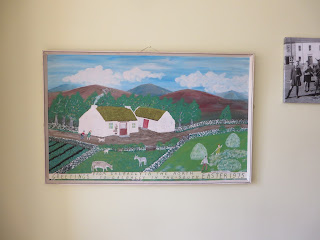
door, and some hills. Idyllic. The daughter of the café said 'There's a fellah
who comes in here now and again, and he's been there'. She had made and was eating a snack of fried
chipolata sausages on a piece of toast.

Caroline pointed out a town shown on the
map, called Hospital. A family she knew lived there and found it impossible to
get life assurance, because each time they filled out a form, the insurance
company would refuse to cover anyone who actually lived in Hospital.
As in England, you do get that same thing
in Ireland where the landscape changes almost in a blink from one exact kind to
another - in just a few metres rise in altitude, or a few twists of the road,
you move from broad to enclosed, or wet to dry…. And so we crossed the moors, went through
plantations, kept company with rivers, danced along the zigzag low-roads,
always with the green and white verges filled with cow parsley, and sometimes
with fat rolling collars of gorse covered in gold. There are not many people
walking about. Not many people at all, in fact.
We stopped at the ancient town of Mallow
for lunch - this is a centre for that literary exercise shown on Mrs Mulvey's
map, for Spenser, Trollope, Thackeray, Dervla Murphy, Elizabeth Bowen, William
Trevor and more can all be pinned down onto the land around here. At some point, someone decided Mallow ought
to be looked after, maybe based on the railway being here, maybe on the fine
19th century houses lining the high street, maybe on the Spa which was developed
a couple of hundred years ago - emulating Bath, with a thriving colony of
rakes, and finally succumbing to boredom, inertia. It's housed in a fierce
mock-Tudor villa which is now mostly offices. Maybe the healing waters are
still there underneath, bubbling away at 70 degrees Fahrenheit. Anyway, Mallow is a very cheerful place, full
of those little shops and lots of bustle, and an excellent tourist office, and
some statues. Here is where 'The Nation' newspaper was founded, and also where
someone went and blew up part of the old 10-arch bridge at some point. I spotted a charming and neglected little
house with partial shop-front, and went into the estate agent's shop to find
out what it might be to buy. His office
smelled unmistakably of farts. 'Fifty to sixty,' he said. 'Thousand'. I
fantasized getting it and doing it up as a holiday cottage and I think if you
offered twenty they'd bite your hand off.
You'd have to spend eighty or more on it.
More roads, more rivers and bridges. Herds
of cattle of mixed breed. And then the unmistakable light in the sky which
comes from the sea beyond the horizon, and great clumps of rock started to poke
through the grass in the gardens and fields. We were winding down towards
Bantry Bay. It's too early in the year for
the fuchsia hedges to be flowering, but there are lots of other colours,
including occasional clumps of London Pride (my favourite garden plant when I
was a little child). Are these native and wild or brought over and naturalised?
Dunno.
Bantry with its huge deep rhea of a bay
snuggles into the back of it, with a statue of Wolf Tone contemplating the
water. Our hotel was - well - spinked up, but dreary in a way, with long
corridors and no wifi in the rooms. We had tea in the reception lounge and plotted
our evening. Then we headed back to the town - to walk through rain showers,
admire the window displays and the creaky old watermill by the library. This was a flour mill (18thC and employing
hundreds of workers), and then a wool-factory mill (19/20th century employing
40 workers), but the owner at that time suddenly closed it down and dismantled
everything 'to the anger of the people'.
Now it's a forlorn iron sculpture with intermittent movement, and nice
waterfall to one side of it.
The dozens of small shops are doing ok,
though perhaps under some strain. Small supermarkets (and large ones) are
creeping in. Beware! Ma Murphy's bar has
a long history of diversification. It's a long thin shop, which once had a
forge at the back, accessed from a lane. Then (working towards the street end
of the business) a bar, a general shop and a tiny snug. (If you know the
wonderful Bear Inn in Faversham you will get the general layout, but Ma
Murphy's does not have a separate corridor for access). There's no longer a
trade in shoeing horses of course, so now it's all about the alcohol. The snug
at the front is a bit of a store-room for stuff, the bar and music room and
garden are all in use…. But we found the old shop is a showcase for Ireland's
Oldest Domestic Appliance - a fridge which recently celebrated its 75th
birthday and is still going strong. It may once have been white, but is now tobacco
brown. Inside, the ice-box door is broken but there is still a great clump of
ice up in that corner. It starred on
national radio on its birthday and appeared in celebrity magazines etc. The dark bar in the next room is crammed with
stuff, and a few Irishmen. The rest of the company are English but picturesque.


Supper was in the incomparable O'Connors -
costing less than €140 for the three of us, superb cooking, wonderful
sauvignon, serious and friendly atmosphere, with 11 people (who had taken up
the tempting early-bird offer) finishing their meals while we ate and a further
10 arriving before we left. The staff are all female including the chef. We had calamari, focaccia, scallops, lamb,
monkfish and slow-roast pork between us.
In your face, Oxfordshire swank-pub. This was cheaper, better, smoother,
friendlier, and utterly more professional.
I think this is one of the best restaurants I have been to in my life.
So - today we will explore the great Beara
peninsular, maybe get across to Dursey Island in the precarious cable-car (or
maybe not). We'll be in Kenmare tonight, and head back to Thurles tomorrow.
Subscribe to:
Posts (Atom)