Last night, my brother sent the following information about our father:
He was with the Royal Artillery, ostensibly, but I think he was doing general duties with the British garrison. There was a dispute between Italy and Yugoslavia as to who owned Trieste. He said he was travelling in the back of an open truck which came under sniper fire. The driver, a local bloke and possibly in on it, stopped and ducked under the dashboard. Marcus jumped over into the cab and took the wheel and drove away receiving a clip on the foot from a bullet fragment.
That's about it. He also told me about an English officer's wife who had a dark complexion and was mistaken for a local girl. She was attacked in the street by locals who thought she was a consorting with the enemy. Apparently the CO ordered all the non-combatants (cooks, clerks, drivers, mechanics etc.) to line up along the waterfront in the evening and then walk slowly through the town with their belts swinging in their hands. They smashed every cafe and shopfront and beat the crap out of anyone who objected. There was no more trouble after that.
Not sure of the date but probably early 1946.
Friday, 21 August 2015

Jan Morris, Barbarians, Loo Seats
So many of the things Jan Morris described in her book ‘Trieste’ are still true, even though it was written 14 years ago. She talks about the calm of the city, how well-dressed people are, their civic pride, the international sense of the place, the strengths of the bourgeoisie, the culture. I have just been reading her account of the statuary in the Tommasini Gardens… She points out that James Joyce, the only outsider allowed into the pantheon of respect, is distinguished or circumscribed by a strange kind of frame behind his head, like a rectangular halo, whereas I was looking at how all the heroes are male, and female statuary is relegated to positions of furious homage or welcome – flying round the great botanist Tommassini himself, or draped around doorways and pediments (banks, insurance offices, cinemas). The females are all naked or semi-naked. The men are mostly in overcoats and hats.
But Morris’s book is such a pleasure to read, so rich and well-researched, I will seek out more when I get home. She pulls in all sorts of characters and stories from the past, and weaves them together with careful observation and anecdote, whereas I think I dwell rather too much on happenstance and (possibly meaningless) incident. I know I rely on tiny events to cast light on the greater world, but perhaps I can start to incorporate wider ideas.
Today, I remembered, this time, to take with me a Swing the Bridge badge from our current fundraising campaign, to photograph it at the fixed bridge over the Canal Grande – which Jan Morris described as having some nice old boats, some half-sunk… These have all gone, to be replaced by lots of white plastic ones, but the fruit market is still there in the mornings, and various coffee bars (well known to James Joyce) are still happily in business.
Our plan was to go to the so-called ‘Venetian fishing village’ of Muggia along the coast for lunch. The ferry timetable is usefully published online, but quite wildly erroneous. We arrived on the quay in good time, to see the ferry chugging away over the horizon.
We spent the hour or so before it reappeared by visiting the international coffee exhibition in one of the huge and beautiful trading halls on the seafront. It’s a terrific exhibition and worth going to see – a silver lining in the cloud of the poor public information about the ferry. It makes imaginative claims about how Trieste could once again become the seaport for Eastern Europe, an idea which had occurred to us before. Coffee is a huge international business, and the Illy family of Trieste are doing all they can to make us more aware… It is certainly a city of coffee bars, and the coffees we’ve had have been delicious. I will, in future, go more for Arabica, and away from Robusta, which is grown mostly because it is resistant to disease, rather than for flavour.
They did not include the traditional Eritrean way of making coffee, which I once enjoyed at a resto in Stockwell (with the Hernhill Reading Group), consisting of a tiny table-top brazier on which we roasted our own beans, then a long wait while they were ground up, and then the coffee brought inside a real gourd, hollowed out, and a filter made from a single horse-tail hair, stuffed inside a long pouring tube. The portions of coffee were minute, but it was the best coffee I have ever had – and years later, I still remember it.
The ferry arrived exactly on time according to the schedule pinned up on the quayside: the Green Dolphin. It was very smart, spick and span, clean as a whistle. The trip took 30 mins, past huge tankers, crumbling warehouses, and what seemed to be a colossal steelworks from the age of Tintin.
Muggia is very pretty, small in scale, depending now pretty much on tourists who come girl lunch, but quiet and charming and not too pushy. We had a drink, watched a huge parasol on a restaurant terrace collapse over the parapet in a squall, chose to eat there anyway. We had fish and more fish. Delicious. People sitting on the terrace fled inside when the rain started again – we made space at our table for a voluble local vet and his very quiet girlfriend. Signor Snazzy was multilingual, wanted to practice his English, had lived in London for four years (and Vienna for ten), had views on everything, had been everywhere. He said if we went to Istria (we are planning our next visit), we will find the food inferior with garlic used to mask the off-flavours of bad fish.
We came home on the same sweet ferry, wandered steeply up to the old citadel to see the Duomo and the castle, caught a bus back to the centre, went to view the beautiful railway station as advised by Jan Morris, and then bought an ice-cream (at last) for Andrew. Here we are back at the hotel, preparing for tomorrow’s journey to Rijeka in Croatia. Trieste was regarded as on the edge of barbarian country (Austro-Hungarian Empire?). Our vet thought barbarity begins at Istria, on the edge of the city. We shall see.
A quick note about toilets. They have all been pretty clean. Many are in the Turkish style, which some think are barbarous. I still moan about how loo-seats on the sit-down kind are so poorly anchored. They must be badly designed, and then serially badly abused, for so many of them to be so wonky. Maybe the giant half-naked statuesses of Trieste were making the same point. Who knows?
But Morris’s book is such a pleasure to read, so rich and well-researched, I will seek out more when I get home. She pulls in all sorts of characters and stories from the past, and weaves them together with careful observation and anecdote, whereas I think I dwell rather too much on happenstance and (possibly meaningless) incident. I know I rely on tiny events to cast light on the greater world, but perhaps I can start to incorporate wider ideas.
Today, I remembered, this time, to take with me a Swing the Bridge badge from our current fundraising campaign, to photograph it at the fixed bridge over the Canal Grande – which Jan Morris described as having some nice old boats, some half-sunk… These have all gone, to be replaced by lots of white plastic ones, but the fruit market is still there in the mornings, and various coffee bars (well known to James Joyce) are still happily in business.
Our plan was to go to the so-called ‘Venetian fishing village’ of Muggia along the coast for lunch. The ferry timetable is usefully published online, but quite wildly erroneous. We arrived on the quay in good time, to see the ferry chugging away over the horizon.
We spent the hour or so before it reappeared by visiting the international coffee exhibition in one of the huge and beautiful trading halls on the seafront. It’s a terrific exhibition and worth going to see – a silver lining in the cloud of the poor public information about the ferry. It makes imaginative claims about how Trieste could once again become the seaport for Eastern Europe, an idea which had occurred to us before. Coffee is a huge international business, and the Illy family of Trieste are doing all they can to make us more aware… It is certainly a city of coffee bars, and the coffees we’ve had have been delicious. I will, in future, go more for Arabica, and away from Robusta, which is grown mostly because it is resistant to disease, rather than for flavour.
They did not include the traditional Eritrean way of making coffee, which I once enjoyed at a resto in Stockwell (with the Hernhill Reading Group), consisting of a tiny table-top brazier on which we roasted our own beans, then a long wait while they were ground up, and then the coffee brought inside a real gourd, hollowed out, and a filter made from a single horse-tail hair, stuffed inside a long pouring tube. The portions of coffee were minute, but it was the best coffee I have ever had – and years later, I still remember it.
The ferry arrived exactly on time according to the schedule pinned up on the quayside: the Green Dolphin. It was very smart, spick and span, clean as a whistle. The trip took 30 mins, past huge tankers, crumbling warehouses, and what seemed to be a colossal steelworks from the age of Tintin.
Muggia is very pretty, small in scale, depending now pretty much on tourists who come girl lunch, but quiet and charming and not too pushy. We had a drink, watched a huge parasol on a restaurant terrace collapse over the parapet in a squall, chose to eat there anyway. We had fish and more fish. Delicious. People sitting on the terrace fled inside when the rain started again – we made space at our table for a voluble local vet and his very quiet girlfriend. Signor Snazzy was multilingual, wanted to practice his English, had lived in London for four years (and Vienna for ten), had views on everything, had been everywhere. He said if we went to Istria (we are planning our next visit), we will find the food inferior with garlic used to mask the off-flavours of bad fish.
We came home on the same sweet ferry, wandered steeply up to the old citadel to see the Duomo and the castle, caught a bus back to the centre, went to view the beautiful railway station as advised by Jan Morris, and then bought an ice-cream (at last) for Andrew. Here we are back at the hotel, preparing for tomorrow’s journey to Rijeka in Croatia. Trieste was regarded as on the edge of barbarian country (Austro-Hungarian Empire?). Our vet thought barbarity begins at Istria, on the edge of the city. We shall see.
A quick note about toilets. They have all been pretty clean. Many are in the Turkish style, which some think are barbarous. I still moan about how loo-seats on the sit-down kind are so poorly anchored. They must be badly designed, and then serially badly abused, for so many of them to be so wonky. Maybe the giant half-naked statuesses of Trieste were making the same point. Who knows?
Deep differences
We searched for a new place to stay and found a little hotel nearby. The charming young receptionist – a tall young man speaking pretty good English – offered us breakfast and guaranteed a double room for two nights though we couldn’t inspect it as the place was full.
(Later when we returned to check in after lunch, a forlorn family was being turned away – too late).
We fetched our few bits of baggage, engaged in another round of texts with the very SHOUTY landlord from the apartment (who was still threatening to CALL THE POLICE), and contemplated the different styles of hospitality on offer in Trieste.
Trieste has very distinct districts, and we went to see the old medieval quarter on its steep hillock, where the view few remaining bits of Roman work can be seen – a sorry sight, all over-worked, over-restored, unexplained and neglected. Concrete and modern steel railings adorn it all, and puddles and steep fences. But the tiny twisting alleys and streets are charming, and it’s all very arty. We found fruit shops, delis, museums (free in August and very well presented), antique shops stuffed with nice things, cafes, etc etc. down to the huge quays and wharves, where the massive trade of the whole Austro-Hungarian Empire once burgeoned in the 19th century, before war and politics sucked it all away again, leaving vast structures, buildings, ornaments and not much else.
Talking of ornaments, a stroll through the Thomasini (?) gardens revealed a truly remarkable collection of statue-busts of famous men from Trieste. Dozens of them. Most are wearing hats. Their names, occupations, dates of birth and death are all inscribed, and sometimes a quote from their (evidently infinite) wisdom. Not one woman.
Women get their revenge by draping themselves furiously about the place semi-naked, either around the occasional full-length male heroic statue (a botanist, perhaps), or around doorways. These females are absolutely terrifying, huge.
The atmosphere is very calm, rather middle-aged, though there are plenty of youngsters about, too.
We met a friendly couple at lunchtime – she Scots, he Triestrian. This is their favourite city in Italy, they said.
We went to the Post Office to buy two stamps. To get in, you have to go through an automatic one- or two-person security airlock. How anyone gets in with a buggy, a wheelchair, a dog or a family I do not know. You have to get a queue ticket – but the right one, as they are categorised (but only in Italian)… It’s not easy to distinguish the meanings of the categories, apart from ‘finanzia’ and ‘telefonica’.
We waited about ten minutes in the queue. The atmosphere was – well – languid.
Eventually, our ticket came up, and we asked for our stamps. The woman looked appalled. (We may have been in the wrong category). She checked that these were for simple postcards. For England. She clicked away at her computer. She went to see her supervisor. She went behind a big partition (like an Orthodox iconostasis). She came back with two beautiful aeronautical stamps. She clicked again at her computer. She pulled out a calculator, and added things up. She went to see the supervisor again. She did sums on a bit of paper. Eventually she put a sheet of A4 in the printer and out came two lines of print – a receipt. This she carefully folded in two, and tore off the bottom half of the paper. We git the top but. There! About twenty minutes, all up.
Perhaps the real highlight of the day was the tram trip to Opicina, up on the karst plateau which surrounds the city and kept it isolated from its hinterland for so long. This enchanting little railway was built in the 1920s, and its middle section is so steep it needs an extra push (or help with the braking coming down) from a sturdy extra engine. Andrew was – well – radiant with pleasure watching it all, and I was pleased he was so pleased. We went to the end, stopped at the famous Obelisk on the way back, just about dodged the rain, trundled back down on the next tram, took photos of the distant views, and came back to the city for a stroll, a drink, supper in a bistro (red and white check tablecloths), and then bed. Bliss.
(Later when we returned to check in after lunch, a forlorn family was being turned away – too late).
We fetched our few bits of baggage, engaged in another round of texts with the very SHOUTY landlord from the apartment (who was still threatening to CALL THE POLICE), and contemplated the different styles of hospitality on offer in Trieste.
Trieste has very distinct districts, and we went to see the old medieval quarter on its steep hillock, where the view few remaining bits of Roman work can be seen – a sorry sight, all over-worked, over-restored, unexplained and neglected. Concrete and modern steel railings adorn it all, and puddles and steep fences. But the tiny twisting alleys and streets are charming, and it’s all very arty. We found fruit shops, delis, museums (free in August and very well presented), antique shops stuffed with nice things, cafes, etc etc. down to the huge quays and wharves, where the massive trade of the whole Austro-Hungarian Empire once burgeoned in the 19th century, before war and politics sucked it all away again, leaving vast structures, buildings, ornaments and not much else.
Talking of ornaments, a stroll through the Thomasini (?) gardens revealed a truly remarkable collection of statue-busts of famous men from Trieste. Dozens of them. Most are wearing hats. Their names, occupations, dates of birth and death are all inscribed, and sometimes a quote from their (evidently infinite) wisdom. Not one woman.
Women get their revenge by draping themselves furiously about the place semi-naked, either around the occasional full-length male heroic statue (a botanist, perhaps), or around doorways. These females are absolutely terrifying, huge.
The atmosphere is very calm, rather middle-aged, though there are plenty of youngsters about, too.
We met a friendly couple at lunchtime – she Scots, he Triestrian. This is their favourite city in Italy, they said.
We went to the Post Office to buy two stamps. To get in, you have to go through an automatic one- or two-person security airlock. How anyone gets in with a buggy, a wheelchair, a dog or a family I do not know. You have to get a queue ticket – but the right one, as they are categorised (but only in Italian)… It’s not easy to distinguish the meanings of the categories, apart from ‘finanzia’ and ‘telefonica’.
We waited about ten minutes in the queue. The atmosphere was – well – languid.
Eventually, our ticket came up, and we asked for our stamps. The woman looked appalled. (We may have been in the wrong category). She checked that these were for simple postcards. For England. She clicked away at her computer. She went to see her supervisor. She went behind a big partition (like an Orthodox iconostasis). She came back with two beautiful aeronautical stamps. She clicked again at her computer. She pulled out a calculator, and added things up. She went to see the supervisor again. She did sums on a bit of paper. Eventually she put a sheet of A4 in the printer and out came two lines of print – a receipt. This she carefully folded in two, and tore off the bottom half of the paper. We git the top but. There! About twenty minutes, all up.
Perhaps the real highlight of the day was the tram trip to Opicina, up on the karst plateau which surrounds the city and kept it isolated from its hinterland for so long. This enchanting little railway was built in the 1920s, and its middle section is so steep it needs an extra push (or help with the braking coming down) from a sturdy extra engine. Andrew was – well – radiant with pleasure watching it all, and I was pleased he was so pleased. We went to the end, stopped at the famous Obelisk on the way back, just about dodged the rain, trundled back down on the next tram, took photos of the distant views, and came back to the city for a stroll, a drink, supper in a bistro (red and white check tablecloths), and then bed. Bliss.
Thursday, 20 August 2015
Black hole. You have to laugh....
I am hoping this report will make my fans cry – with laughter. It’s been a bit of a bummer today. Started off ok, my answerphone password problems apparently to be resolved by a text which the service providers said they’ll send in a few hours. (12 hours later, it hasn’t arrived yet). Cross fingers.
And we had a smooth journey to the airport.
But – Andrew’s new Android phone proved to be broken, despite the best efforts of the guys at Dixon's in the terminus. And, because I had decided I would, really, here and now upgrade my phone – and spent a nawful lot of money to do it, I then found that password glitches etc had wiped out all my contacts and photos, and masses of apps, and the promised ‘two hours’ of battery in the new phone turned out to be 40 minutes.
So, as we boarded we knew we were going to be a bit incommunicado when we arrived.
Luckily, the threat of delays caused by French air-traffic controllers proving to be nothing more than a rumour.
But, during the flight which was pretty well perfect, I somehow managed to drop my reading glasses off my head and onto the floor somewhere under or behind my seat. No amount of wriggling or squirming on my part brought them within hands-reach. I tried facing backwards, but no good. I was stretching out into all the cramped spaces round the seat – nothing. Andrew, in the middle seat, tried. Nothing. We got up and tried to see where the spectacles had gone. Couldn’t see them. We asked the poor girl in the third seat (by the aisle) to get up, and then I, and then Andrew, tried to lie down in front of the seats to find them. Nothing. We attracted the attention of the cabin crew. A beautiful and very calm young woman looking more like a film star than a stewardess said she would get them. She lay down on the floor as if she did this every day, and with one elegant flourish of her tiny wrist, she pulled my precious glasses out from their hiding place. Really it was balletic. She just smiled sweetly.
As we approached Trieste, a thick blanket of dark cloud obscured the whole landscape below us, until we came down to a couple of thousand feet. Then it was quite clear that the whole area was being drenched with rain. It looked like – well – England in November. Getting off the plane was like stepping fully-clothed into the shower.
We went through border control, got our bag, bought our bus tickets, found a dryish route to the buses while the rain slammed down around us.
Andrew’s preparatory research showed we needed bus 51 – and there it was. We queued and queued to get on…. The rain pelted down. The driver seemed to be having a deep philosophical conversation with someone ahead of us in the line. There was nowhere else to stand except in the monsoon. Andrew tried hiding under the luggage department lid, in the side of the bus. He may have kept slightly drier but had to stand hunched up like Quasimodo. Eventually the driver opened the second set of doors, and a grateful but sodden line of passengers got into the coach.
Our journey into Trieste was pretty mysterious because it was pouring rain outside, and the windows were all steamed up inside. Nonetheless it was a smooth and quiet journey, quite a different experience from the great Jan Morris’s description of what the approach to Trieste is like. I cannot in any way compete with her remarkable, erudite and brilliantly written account of the city, and I thoroughly recommend it to you, pausing only to point out that it’s currently cheaper to buy it in paperback than it is to download it on Kindle, which is a degree further in the economics of publishing than I can aspire to understand.
We passed through small town and suburbs, then could see little glimpses of the sea to our right, and went below and though great rocky cliffs, and finally arrived in a dry but dark bus station. The loos were clean – somehow I got in and out without paying. Our little map lured us out into the rain, to find our apartment.
We had two pull-alongs, a backpack, and two umbrellas. The way to cross the roads here is rather German – wait for the green man. The rain poured down. We were splashed with puddle spray, somewhat.
We carved our way through the slightly weird streets – cobbles, utterly grand and knob-covered facades, tramlines, zebra-crossings which overlap at the corners, lots of closed shops, black guys trying to sell umbrellas to the masses of people who already held umbrellas of every possible design and colour…. Worrying, really, as it seems to indicate that it rains a lot here, which none of the guidebooks said.
We went up and down, back and forth, looking for Via de la gimmnastica…. But it was nowhere to be found. Back and forth. We asked. We asked again. And again. We walked to and fro, up and down. Eventually we found it, labelled as Via Cornorio della Cornorio, or something. The rain kept coming down. Sirens wailed. We found no. 13, which was described on Booking.com as ‘a hotel’. It is a dark entrance, narrow stairs. No-one in sight. We tried various doors. We retreated, and being phone-less, asked in the adjacent hair salon if we could telephone the owner of the apartment. The ladies, who were having a party with large glasses of pink wine (or gin?) were very helpful, let us ring, tried ringing the number themselves…. No answer. We tried ringing England and after listening to a lot of music, got through. The owner had left a message – long after we had left home – explaining that the key is in a little box, with a pin code. We were in!
But – oh deary me! The flat stinks of cigarettes. There are no windows – just two openings into the bottom of a lift shaft. It is pitch dark. There is no wifi. The air conditioning appears not to work. In its way, this is as horrible as the notorious Hotel Moderns in Paris, which is rated as one of the ten worst places to stay in that formidably sanguine city. True, this place is clean and modern inside, but it’s a pit.
We dump our stuff, venture out to find something to eat, out into the interminable Mancunian rain. Oh Italy! Oh Trieste! Everywhere seems to be closing down. We collapse into a trattoria – Andrew has a dish of utterly divine carpaccio di tonno, and I mis-choose with some very salty ham, and then a very al dente pasta.
Back into the smokehouse of the apartment, there is a message asking if things are ok, and I back (now that my new phone is partly charged up)…. I say it is not alright, and I say why. Back comes a reply – he thinks I am being aggressive and threatens to call the police. I repeat my complaints, say we will find somewhere else tomorrow. Andrew is disgruntled. We have had a long day.
I know it’s still raining because I can hear the traffic on the wet roads nearby (can’t see them, of course). There is loud laughter, thumping and banging from elsewhere in the building, a loud ping-pong announcement noise which we used to hear in airports, the clash of pots and pans, furniture scraping on the floors, men talking loudly, keys rattling in doors, the smell of fags all through. Oh, Italy!
This morning, the sun is shining. We have had a lot of very shouty emails from the landlord, threatening TO CALL THE POLICE.... But we have checked out and found a nice little hotel which claims to have wifi in each bedroom. This blog is posted from a cafe. Now we are off sightseeing. Andrew says the loo here is in the Turkish style....
And we had a smooth journey to the airport.
But – Andrew’s new Android phone proved to be broken, despite the best efforts of the guys at Dixon's in the terminus. And, because I had decided I would, really, here and now upgrade my phone – and spent a nawful lot of money to do it, I then found that password glitches etc had wiped out all my contacts and photos, and masses of apps, and the promised ‘two hours’ of battery in the new phone turned out to be 40 minutes.
So, as we boarded we knew we were going to be a bit incommunicado when we arrived.
Luckily, the threat of delays caused by French air-traffic controllers proving to be nothing more than a rumour.
But, during the flight which was pretty well perfect, I somehow managed to drop my reading glasses off my head and onto the floor somewhere under or behind my seat. No amount of wriggling or squirming on my part brought them within hands-reach. I tried facing backwards, but no good. I was stretching out into all the cramped spaces round the seat – nothing. Andrew, in the middle seat, tried. Nothing. We got up and tried to see where the spectacles had gone. Couldn’t see them. We asked the poor girl in the third seat (by the aisle) to get up, and then I, and then Andrew, tried to lie down in front of the seats to find them. Nothing. We attracted the attention of the cabin crew. A beautiful and very calm young woman looking more like a film star than a stewardess said she would get them. She lay down on the floor as if she did this every day, and with one elegant flourish of her tiny wrist, she pulled my precious glasses out from their hiding place. Really it was balletic. She just smiled sweetly.
As we approached Trieste, a thick blanket of dark cloud obscured the whole landscape below us, until we came down to a couple of thousand feet. Then it was quite clear that the whole area was being drenched with rain. It looked like – well – England in November. Getting off the plane was like stepping fully-clothed into the shower.
We went through border control, got our bag, bought our bus tickets, found a dryish route to the buses while the rain slammed down around us.
Andrew’s preparatory research showed we needed bus 51 – and there it was. We queued and queued to get on…. The rain pelted down. The driver seemed to be having a deep philosophical conversation with someone ahead of us in the line. There was nowhere else to stand except in the monsoon. Andrew tried hiding under the luggage department lid, in the side of the bus. He may have kept slightly drier but had to stand hunched up like Quasimodo. Eventually the driver opened the second set of doors, and a grateful but sodden line of passengers got into the coach.
Our journey into Trieste was pretty mysterious because it was pouring rain outside, and the windows were all steamed up inside. Nonetheless it was a smooth and quiet journey, quite a different experience from the great Jan Morris’s description of what the approach to Trieste is like. I cannot in any way compete with her remarkable, erudite and brilliantly written account of the city, and I thoroughly recommend it to you, pausing only to point out that it’s currently cheaper to buy it in paperback than it is to download it on Kindle, which is a degree further in the economics of publishing than I can aspire to understand.
We passed through small town and suburbs, then could see little glimpses of the sea to our right, and went below and though great rocky cliffs, and finally arrived in a dry but dark bus station. The loos were clean – somehow I got in and out without paying. Our little map lured us out into the rain, to find our apartment.
We had two pull-alongs, a backpack, and two umbrellas. The way to cross the roads here is rather German – wait for the green man. The rain poured down. We were splashed with puddle spray, somewhat.
We carved our way through the slightly weird streets – cobbles, utterly grand and knob-covered facades, tramlines, zebra-crossings which overlap at the corners, lots of closed shops, black guys trying to sell umbrellas to the masses of people who already held umbrellas of every possible design and colour…. Worrying, really, as it seems to indicate that it rains a lot here, which none of the guidebooks said.
We went up and down, back and forth, looking for Via de la gimmnastica…. But it was nowhere to be found. Back and forth. We asked. We asked again. And again. We walked to and fro, up and down. Eventually we found it, labelled as Via Cornorio della Cornorio, or something. The rain kept coming down. Sirens wailed. We found no. 13, which was described on Booking.com as ‘a hotel’. It is a dark entrance, narrow stairs. No-one in sight. We tried various doors. We retreated, and being phone-less, asked in the adjacent hair salon if we could telephone the owner of the apartment. The ladies, who were having a party with large glasses of pink wine (or gin?) were very helpful, let us ring, tried ringing the number themselves…. No answer. We tried ringing England and after listening to a lot of music, got through. The owner had left a message – long after we had left home – explaining that the key is in a little box, with a pin code. We were in!
But – oh deary me! The flat stinks of cigarettes. There are no windows – just two openings into the bottom of a lift shaft. It is pitch dark. There is no wifi. The air conditioning appears not to work. In its way, this is as horrible as the notorious Hotel Moderns in Paris, which is rated as one of the ten worst places to stay in that formidably sanguine city. True, this place is clean and modern inside, but it’s a pit.
We dump our stuff, venture out to find something to eat, out into the interminable Mancunian rain. Oh Italy! Oh Trieste! Everywhere seems to be closing down. We collapse into a trattoria – Andrew has a dish of utterly divine carpaccio di tonno, and I mis-choose with some very salty ham, and then a very al dente pasta.
Back into the smokehouse of the apartment, there is a message asking if things are ok, and I back (now that my new phone is partly charged up)…. I say it is not alright, and I say why. Back comes a reply – he thinks I am being aggressive and threatens to call the police. I repeat my complaints, say we will find somewhere else tomorrow. Andrew is disgruntled. We have had a long day.
I know it’s still raining because I can hear the traffic on the wet roads nearby (can’t see them, of course). There is loud laughter, thumping and banging from elsewhere in the building, a loud ping-pong announcement noise which we used to hear in airports, the clash of pots and pans, furniture scraping on the floors, men talking loudly, keys rattling in doors, the smell of fags all through. Oh, Italy!
This morning, the sun is shining. We have had a lot of very shouty emails from the landlord, threatening TO CALL THE POLICE.... But we have checked out and found a nice little hotel which claims to have wifi in each bedroom. This blog is posted from a cafe. Now we are off sightseeing. Andrew says the loo here is in the Turkish style....
Wednesday, 19 August 2015
Heading to Trieste. Trouble with the electronics....
Standing on the platform at Stratford station, we can get a burn from various past ages. The Stone Age – clinkers on the track; Iron Age – the rails, the overhead cables, the huge rust-steel bridge over the whole are all; the Victorian Age – the rampant drive to consumerism in the vast shopping mall beside the platforms; the 20th century – planes overhead, tube map, the announcements, the privatised railway companies whose names are sonorously red out before any other details are given; the Information Age – the weird non-human nature of those announcements, the digital displays, the isolation….
We churn out through Essex, spotting the Shenfield Shark resting like a strange arctic fishy box on its siding beside the main line. Every time a train comes past us in the opposite direction, our coach seems to have been punched, with a loud bang as the airmass hits us – and we are in coach 4 of 12, or something.
Braintree Station is a gem – a charming proud little Victorian terminus with a single track, slightly curved, and a wealth of woodwork and craftsmanship in every quarter – panelling, cornices, strapwork, and all at a nice scale and beautifully looked after.
We are met by our friend Jeremy Nicholas who is late because of the traffic jams – he doesn’t think much of the town, but I like the fountain, and the buildings…. The countryside is benign, rich. The harvest is all done, already. I remember how it used to go on for so much longer, when the grain was poured into sacks in the fields straight from the combines, and the straw lay on the ground in lines….. Now it’s done by huge machines on contract, and all over in a blink. The fields look almost toasted.
We have a lovely evening, talking with Jezza and Jill, and sleep in pure white linen, and now we are off to the airport to go to Trieste. Our gadgets are playing up. Can we get it all fixed before we fly?
We churn out through Essex, spotting the Shenfield Shark resting like a strange arctic fishy box on its siding beside the main line. Every time a train comes past us in the opposite direction, our coach seems to have been punched, with a loud bang as the airmass hits us – and we are in coach 4 of 12, or something.
Braintree Station is a gem – a charming proud little Victorian terminus with a single track, slightly curved, and a wealth of woodwork and craftsmanship in every quarter – panelling, cornices, strapwork, and all at a nice scale and beautifully looked after.
We are met by our friend Jeremy Nicholas who is late because of the traffic jams – he doesn’t think much of the town, but I like the fountain, and the buildings…. The countryside is benign, rich. The harvest is all done, already. I remember how it used to go on for so much longer, when the grain was poured into sacks in the fields straight from the combines, and the straw lay on the ground in lines….. Now it’s done by huge machines on contract, and all over in a blink. The fields look almost toasted.
We have a lovely evening, talking with Jezza and Jill, and sleep in pure white linen, and now we are off to the airport to go to Trieste. Our gadgets are playing up. Can we get it all fixed before we fly?
Saturday, 8 August 2015
The light
We're home again, and I am throbbing with the loss of the amazing light on that shore. The Øresund is utterly astonishing in its capacity to grab the light from the skies and massage it and work on it and then throw it back out at the heavens, so that the colours of the sky or the clouds are constantly reinterpreted and swept in to your feet by the waves, and the radiance - the sheer, shining, uplifting brightness of it is flung and bounced and caught and threaded and hung all about you. Sometimes everything was purple. Sometimes blue. Or red. Or green, or pale arctic blue. But always mesmerising. I tried making paintings of it, and I tried photographing it, but none of the images come anywhere near the ecstatic emotional quality of actually being there.
I tried painting some of the little smack-boats in the harbour .

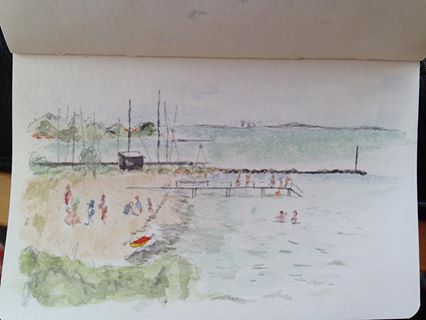
And I tried painting the beach just along from Chris and Bente's house - children and teens in the water, the little jetty, the black edge of the harbour. Please don't let my amateur attempts put you off, if you are of a mind to go and see for yourself.

We had supper in a fish-cafe by that harbour. Chris must have had wine before he arrived and was flirtatious with little girls, and did a tiny stomping dance to draw attention to himself. Relatives can be embarrassing. The food was delectable - crab, hot-smoked salmon, haddock done like sugar/salt pickled salmon and cut into thin fragrant slices. Nice chips too - these are getting more and more difficult to find, in my experience; the cooks use the cheapest spuds with least flavour, and cheap oil which is frequently rancid or over-heated, and then they do it all too fast and without finesse. When you get a good chip, as for instance, you can at the Gunton Arms in North Norfolk, it's so rare and so wonderful that they should ring peals of bells in honour of the moment.
Yesterday, going home, we went back towards Copenhagen and the airport in some trepidation because the news reports said the police had shot a man believed to have killed two people and the lines into the city were closed. On the train we heard that a railway employee had been mugged at 4am, tied up with tape and dumped in a luggage rack.... It seemed so completely alien in that sweet, gentle, civilised place, that nearly-English-looking and sounding country, where you rarely hear children cry and there is a powerful sense of community..... But, nonetheless, the violence and the madness are there, just under the surface. As I had been reading (and partly reporting to you) this land was the home of violence, for centuries - swift, brutal, organised or random, merciless..... And we had been relaxing and enjoying the most luxurious and gentle of holidays, forgetting about the murderous hatred which powers so much of the world.
We went onto a very very very wide and shallow and flat tourist boat to have a cruise round the 'canals' (docks) in Copenhagen and gawped at the stunning modern architecture - the opera-house, the black diamond (library), the Maersk building, the bank..... Gorgeous. This city has never turned its back on the water the way English town have: Faversham! Take note!!!!! The Danish Royal Yacht lies at anchor, pure 1930s with some radar on top and lots of gold decoration. How lovely. We met with a friend for lunch - ate at the rooftop resto in the old Post Office building... More pickled fish and pretty and tasty bits. A wedding party arrived - flowers were put on the tables for them, and the bride looked very beautiful in tight white lace, and about eight and half months pregnant. We did not see a groom - maybe her family was giving her a 'wedding' all on her own.
Coffee sitting in a side street. A silver shop stuffed with beautifully shining and labelled antique spoons and trays and little pots. Art all over the place. Courtyards leading off courtyards leading off courtyards. The lawcourts with grand portico and steps all stinking of piss. Three dark men huddled on a mattress trying to sleep, tucked into each other's shapes like - well, spoons. The loo in a fastfood resto proving to be rather disgusting and then actually breaking down - an anxious queue getting longer and longer - but the public loo across the street immaculately clean and with no-one using it. The crowds swirling around the Tivoli gardens, more litter than I remember from last time. Lots and lots and lots of foreigners - women in hijabs, black students, middle-eastern children... And the Danes themselves, with a very distinctive style: young men with long hair and short beards, older men with grey beards, and often with soft cotton captain's hats, women with brutally short hair (and bad knees), lots of young women with very short shorts and lovely faces, a very large proportion of the public on bikes, bikes left everywhere and not always locked, lots of people on some kind of motorised skateboards... It's all very endearing and lovely (till someone starts killing someone else).
It was an odd thing that in this land of fabulous design and well-considered public convenience, the elevator to the Left Luggage dept at the main railway station is both far too small for the numbers who want to use it, and subject to those on the top two floors commandeering it so that those with luggage or bikes down in the basement (where the department is based) can almost never get their kit into it. As a result, people are left lugging their bikes and their bags up a narrow, steep set of stairs, bashing each other and any passers-by, and missing their trains to boot. Very funny, unless it's you.
The plane was supposed to leave at 6.55 but in the event was well over 2 hours late, so our early arrival at the airport was a prelude to quite a long stay. We were glad to get away, to chase the sunset across to the west, and see it setting once, twice, three times as we achieved 38,000 feet heading into the darkness. And home does seem dark, compared to Espergaerde. We have had sun all day here in Kent, but I am still thinking of that wide spacious silvery sea, that sizzling, tempting sweep of water, where the morning sun and the light of the day and the evening pours down and casts its spell. I wish I was still there.
I tried painting some of the little smack-boats in the harbour .

And I tried painting the beach just along from Chris and Bente's house - children and teens in the water, the little jetty, the black edge of the harbour. Please don't let my amateur attempts put you off, if you are of a mind to go and see for yourself.
Yesterday, going home, we went back towards Copenhagen and the airport in some trepidation because the news reports said the police had shot a man believed to have killed two people and the lines into the city were closed. On the train we heard that a railway employee had been mugged at 4am, tied up with tape and dumped in a luggage rack.... It seemed so completely alien in that sweet, gentle, civilised place, that nearly-English-looking and sounding country, where you rarely hear children cry and there is a powerful sense of community..... But, nonetheless, the violence and the madness are there, just under the surface. As I had been reading (and partly reporting to you) this land was the home of violence, for centuries - swift, brutal, organised or random, merciless..... And we had been relaxing and enjoying the most luxurious and gentle of holidays, forgetting about the murderous hatred which powers so much of the world.
We went onto a very very very wide and shallow and flat tourist boat to have a cruise round the 'canals' (docks) in Copenhagen and gawped at the stunning modern architecture - the opera-house, the black diamond (library), the Maersk building, the bank..... Gorgeous. This city has never turned its back on the water the way English town have: Faversham! Take note!!!!! The Danish Royal Yacht lies at anchor, pure 1930s with some radar on top and lots of gold decoration. How lovely. We met with a friend for lunch - ate at the rooftop resto in the old Post Office building... More pickled fish and pretty and tasty bits. A wedding party arrived - flowers were put on the tables for them, and the bride looked very beautiful in tight white lace, and about eight and half months pregnant. We did not see a groom - maybe her family was giving her a 'wedding' all on her own.
Coffee sitting in a side street. A silver shop stuffed with beautifully shining and labelled antique spoons and trays and little pots. Art all over the place. Courtyards leading off courtyards leading off courtyards. The lawcourts with grand portico and steps all stinking of piss. Three dark men huddled on a mattress trying to sleep, tucked into each other's shapes like - well, spoons. The loo in a fastfood resto proving to be rather disgusting and then actually breaking down - an anxious queue getting longer and longer - but the public loo across the street immaculately clean and with no-one using it. The crowds swirling around the Tivoli gardens, more litter than I remember from last time. Lots and lots and lots of foreigners - women in hijabs, black students, middle-eastern children... And the Danes themselves, with a very distinctive style: young men with long hair and short beards, older men with grey beards, and often with soft cotton captain's hats, women with brutally short hair (and bad knees), lots of young women with very short shorts and lovely faces, a very large proportion of the public on bikes, bikes left everywhere and not always locked, lots of people on some kind of motorised skateboards... It's all very endearing and lovely (till someone starts killing someone else).
It was an odd thing that in this land of fabulous design and well-considered public convenience, the elevator to the Left Luggage dept at the main railway station is both far too small for the numbers who want to use it, and subject to those on the top two floors commandeering it so that those with luggage or bikes down in the basement (where the department is based) can almost never get their kit into it. As a result, people are left lugging their bikes and their bags up a narrow, steep set of stairs, bashing each other and any passers-by, and missing their trains to boot. Very funny, unless it's you.
The plane was supposed to leave at 6.55 but in the event was well over 2 hours late, so our early arrival at the airport was a prelude to quite a long stay. We were glad to get away, to chase the sunset across to the west, and see it setting once, twice, three times as we achieved 38,000 feet heading into the darkness. And home does seem dark, compared to Espergaerde. We have had sun all day here in Kent, but I am still thinking of that wide spacious silvery sea, that sizzling, tempting sweep of water, where the morning sun and the light of the day and the evening pours down and casts its spell. I wish I was still there.
Thursday, 6 August 2015
Possessions
Chris and Bente have sold their exquisite beach house to remove to a practical bungalow just a short way inland – down a quiet nondescript driveway, not far from the shops and medical centre, with three bedrooms and a wide South-facing garden. Bente’s arthritis is increasingly worrying, and their house on the beach – constrained by merciless planning laws – is too small to allow the installation of a lift and in any case is too much crammed with their treasures. They live in a cabinet of curiosities, not valuable except to them – mementoes, colours, paintings and photos, books, china and so on. We came to see them partly to say goodbye to the building, resting as it does on one of the allotments of land lying along the beach, where the easterly river or sound gives a clear view of Sweden a few miles away, and with scintillating light, and a never-ending panorama of boats and shipping tripping back or forth, and a huge sky taking the eye and imagination away to historic distances. I am very slightly reminded of the Bosphorus in Istanbul – not for the land-, sea- or sky-scape, but the incessant movement of craft on the water, from tiny kayaks and rowing-boats up to huge-scale cruise liners and tankers, which mercifully seem to favour the eastern, Swedish bank – maybe they like buying cheaper tobacco rather than booze, being on that side of the international line.
Bente in particular has very mixed feelings about leaving their house. It is she who swims once, twice, three times a day in summer. It is she who loves these beautiful objects – and I think is utterly possessed by the light, the colours of the sea. Chris – who effectively redesigned the house with the help of an architect, changing it from a charming Deco cottage into a Modern dwelling – is already thinking about how he can extend and alter the new place – which (from the very limited view we had if it) is just a plain, yellow-brick, 20-year old standard bungalow.
I suggested that Bente could, to alleviate her grief at leaving her seaside house, could from time to time, book herself into this little bed-and-breakfast place where they have placed us. It too is right on the beach, though only single-storey, and with a public path outside the beach gate. However, it has wild rosa rugosa hedges filling the air with scent, and a fine clear sandy access to the water just 50 yards away, whereas the beach at her little house is only accessed over harsh pebbles which through the funnelling action of the water are usually covered with slippery sea-reed stalks. So, she could be up in her new quiet spacious house most of the time and have weekends away back at her beloved water. 600 krone a night.
Of the arthritis I will say this: that whereas there are hardly any obese people to be seen here, there are masses of women in particular who clearly have bad knees (or hips). They walk in a distinctive way, as Bente does. I would be interested to know if their diet with so many potatoes and tomatoes has anything to do with it – those solanum toxins which I only very recently read about.
She commented on how lively and well Andrew and I seem to be (and are), and I said I am sure it’s our JuicePlus+ …
My reading for this trip is Michael Pye’s acclaimed book called ‘The edge of the world’, all about the North Sea – very apposite and informative. I really enjoyed the early section about the Frisians (who?)…. It seems to tie in with my current activities trying to help get Faversham Creek (and other small tidal places like Deptford and Rye) restored to their proper place in the collective and statutory imagination as being essentially maritime – rather than just residential development opportunities. Here in the tiny harbour are fewer than half a dozen wooden fishing boats, called smakkejollen – very like the Whitstable smacks back in Kent.
From these very waters and margins came cultures which resisted Romanisation, depending on common law and custom, exploratory, matter-of-fact, tribal rather than feudal, craft-based. They allowed some women unlimited power and scope to lead, while treating others as (worse than?) cattle – sexual rubbish, slaves, group-rape objects. Slavery was of course a colossal, global trade – from the Arab lands outwards, and everyone, every kingdom was both busily engaged in it and prey to it. Men, women and children were the unfortunate chattels. I can only shudder.
Yesterday, we tripped down the coast a short way to Louisiana, that beacon of public art – a sprawling mansion of gardens and galleries, filled with works of high status and thronging with people. The special show at the moment is our very own Peter Doig, whose colossal paintings fill the great walls with colour and wonder. I am very tempted to go back there again today – our last full day here. Chris and Bente are lucky having this marvellous gallery so close (2 bus-stops) away. It no doubt inspires them in their own collections of brilliant objects. Bente has given away box loads of things to help make their move simpler. It is very hard to avoid the modern curse of ‘too much stuff’. Maybe those who bought slaves (for ‘free’ sex or labour, or whatever), long ago (or still today), had the same problem. What to do with it all. Where to keep it. What to chuck out.
Bente in particular has very mixed feelings about leaving their house. It is she who swims once, twice, three times a day in summer. It is she who loves these beautiful objects – and I think is utterly possessed by the light, the colours of the sea. Chris – who effectively redesigned the house with the help of an architect, changing it from a charming Deco cottage into a Modern dwelling – is already thinking about how he can extend and alter the new place – which (from the very limited view we had if it) is just a plain, yellow-brick, 20-year old standard bungalow.
I suggested that Bente could, to alleviate her grief at leaving her seaside house, could from time to time, book herself into this little bed-and-breakfast place where they have placed us. It too is right on the beach, though only single-storey, and with a public path outside the beach gate. However, it has wild rosa rugosa hedges filling the air with scent, and a fine clear sandy access to the water just 50 yards away, whereas the beach at her little house is only accessed over harsh pebbles which through the funnelling action of the water are usually covered with slippery sea-reed stalks. So, she could be up in her new quiet spacious house most of the time and have weekends away back at her beloved water. 600 krone a night.
Of the arthritis I will say this: that whereas there are hardly any obese people to be seen here, there are masses of women in particular who clearly have bad knees (or hips). They walk in a distinctive way, as Bente does. I would be interested to know if their diet with so many potatoes and tomatoes has anything to do with it – those solanum toxins which I only very recently read about.
She commented on how lively and well Andrew and I seem to be (and are), and I said I am sure it’s our JuicePlus+ …
My reading for this trip is Michael Pye’s acclaimed book called ‘The edge of the world’, all about the North Sea – very apposite and informative. I really enjoyed the early section about the Frisians (who?)…. It seems to tie in with my current activities trying to help get Faversham Creek (and other small tidal places like Deptford and Rye) restored to their proper place in the collective and statutory imagination as being essentially maritime – rather than just residential development opportunities. Here in the tiny harbour are fewer than half a dozen wooden fishing boats, called smakkejollen – very like the Whitstable smacks back in Kent.
From these very waters and margins came cultures which resisted Romanisation, depending on common law and custom, exploratory, matter-of-fact, tribal rather than feudal, craft-based. They allowed some women unlimited power and scope to lead, while treating others as (worse than?) cattle – sexual rubbish, slaves, group-rape objects. Slavery was of course a colossal, global trade – from the Arab lands outwards, and everyone, every kingdom was both busily engaged in it and prey to it. Men, women and children were the unfortunate chattels. I can only shudder.
Yesterday, we tripped down the coast a short way to Louisiana, that beacon of public art – a sprawling mansion of gardens and galleries, filled with works of high status and thronging with people. The special show at the moment is our very own Peter Doig, whose colossal paintings fill the great walls with colour and wonder. I am very tempted to go back there again today – our last full day here. Chris and Bente are lucky having this marvellous gallery so close (2 bus-stops) away. It no doubt inspires them in their own collections of brilliant objects. Bente has given away box loads of things to help make their move simpler. It is very hard to avoid the modern curse of ‘too much stuff’. Maybe those who bought slaves (for ‘free’ sex or labour, or whatever), long ago (or still today), had the same problem. What to do with it all. Where to keep it. What to chuck out.
Subscribe to:
Posts (Atom)