Tuesday, 24 September 2019

Accommodations


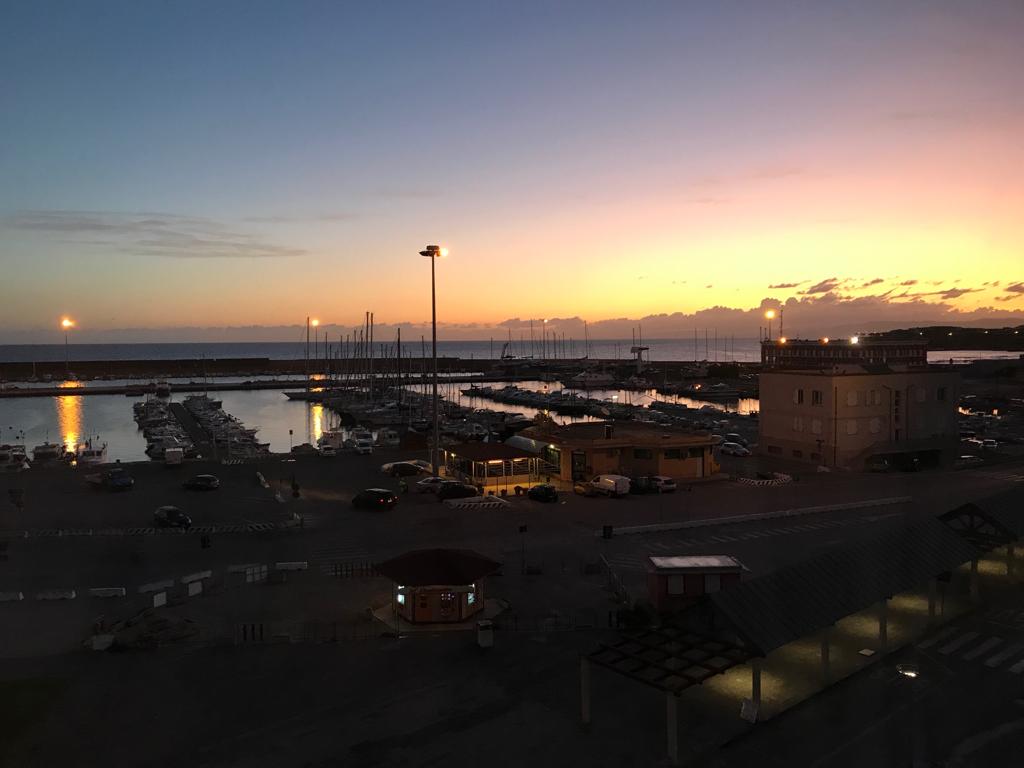
We are staying in a large apartment overlooking the busy little port of Porto Torres.  The light, especially at dawn and dusk, is lovely.  The flat is up in the attics of the Hotel Elisa, which looks to have been built in the 1930s - I guess this flat was installed or modernised about 20 years ago. 


No expense was spared - it’s lavishly arranged with tiling, superb wooden floors, folding doors, concealed lighting, and a recently installed fitted kitchen. The windows to the front overlook the port with its pretty Aragonese tower, and at the back there’s a small quiet terrace with washing machine and dining table.  


The sad thing is that despite the glamorous fixtures, there are a number of niggling problems in the apartment - the loo seat is not properly fixed. The wifi barely works. The hot water has to come from a long distance and is very intermittent.  The automatic lighting on the landing outside the door is extremely random in its operation. The bathroom mirror has started to lose its silvering. This is how we all wear out, I suppose. 

At the front we hear the street, the traffic, the shipping, the fishing boats and tugs, machinery, and all the noises of the passers-by.  At the back we hear the children playing in the piazza behind the building, and the screeching orchestra of the starlings as they flock back to town for the night. The double-glazing is a very effective sound-barrier, thank goodness, as these noises barely stop at night.  

However, the constant movement of the ships is fascinating. Some are just small local ferries, and some are great international things - perhaps heading to Barcelona or Genoa.  Their decorations are wild - one quite big one is dressed as Batman - I can see it from where I’m sitting on the sofa at the back of the room.


Today we are planning to go a little inland, to Sássari, and some prehistoric sites…   Sássari was established as the port here declined in the 11th century…. one reason seems to have been attacks by Genoese and Saracens, not long after the beautiful basilica of San Gavino was built.  It’s rather remarkable that the port should have been so active and such an important little place for such a very long time.

Monday, 23 September 2019

Continuities


I did wonder if we might have thunder but the forecast said it would be fine…. At 5am the rain must have been pelting down - our laundry drying on the terrace got wetter than when I hung it up.  My housewifely soul was dismayed….

We went to explore the environs. 


A small man (with a very round face and very round glasses and a very very very curly moustache) in the tourist office was helpful, spoke enthusiastic Italian-English, and told us the many many many choices we had if we want to make a visit to Isola d’Asinara.  We couldn’t see it yesterday in the humid air but it sits on the horizon today looking very attractive, and we thought we'd see if we could go there.  (Having been a dire prison for hundreds of years the island is now a wildlife sanctuary with white donkeys).  Evidently there are two different ferries leaving from different ports at different times and with different last-trip back times. One takes 20 minutes but is a fair drive away. The other leaves from near the hotel but takes one hour and fifty minutes each way.  You cannot take your own car.  There is a huge variety of ways to get about: walk, bike, taxi, road train, personal guide, on piste, off piste….  Some of these go to all the places, some do not.  You must decide and book any or all of these individually - and some in combination - before you go, preferable one or two days in advance. If you want a bike, say, at one place, you have to contact the owners who happen to be another place to find out if they can meet you there, and hand it over, and then later collect it, in enough time to get your ferry back.  There are three restaurants which you have to book before you go. He gave us FOUR pages of printed lists of phone numbers to choose from.  We have to make these calls ourselves, as the tourist office does not offer this kind of joined-up service.  Despite his enthusiasm, we have decided not to go….  

Next we found a booth dispensing a wide range of cannabis products. I would have bought some but the card-machine didn’t work.  


We walked on to the very old basilica of St. Gavino. It was built by Pisans between 1030 and 1080, and incorporates a lot of Roman columns dug up from nearby. It is named for a soldier martyred by a legendary Roman/mythical king called Re Bárbaro … Gavino was supposed to guard two silly Christians who refused to obey orders (from Diocletian?) to revert to paganism, and instead, he decided he ought to be a Christian too. So he was beheaded, along with them, in 304 AD. So these are the Trei Mártiri Turritani: San Gavino, San Proto and San Gianuario. The church which is rather lovely - long and plain, with an apse at each end - has their three life-size painted replicas on a sort of catafalque and people have come to pray and touch their little painted feet for a long time. Ancient courtyards on either side of the church have lodgings for pilgrims.  


We had a pizza lunch - first of the holiday - and then went back past the Tourist Office to see the Roman archaeological site….    There’s a wonderful seven-arched Roman bridge crossing the river to the west of the town, and a large area, partly excavated, with no less than three large public thermal baths, complete with mosaics, columns etc.    


We had a guide who spoke only Italian and rattled through his script so it was hard to get all the details, but the remaining structures and plumbing are pretty amazing. This was a trading port with a lot of money, nothing military about it, but he wasn't able to say how life was lived - how it was for the women and children, or the slaves….  From the top of the site you can see the modern ferry boats, the 19th century chemical factory towers, the petrochemical stacks, and this sprawl of stones and walls dating from 1st century BC through to late Roman - very interesting.  It all seems to be continuous, and it’s clear the later structures were just piled onto the older ones - great pillars hammered through delicate mosaics, including one of Orfeo - sadly you can only view this ‘upside down’… the public access is at the wrong side, so you can’t really see it properly. But it is very lovely.  The little fishpool shown here is all mosaics, and there are so many kinds of fish, all identifiable, including moray eels, squids, etc.  One of the bigger houses nearby has a mosaic saying 'Benvenuto a mia casa'- very hospitable. 


As we came to the end of the tour, a little train arrived at the station beside the site and Andrew went to see it. I said to the guide, 'He likes trains!' and he asked me ...'Tren? Treni?...' so I said 'Ah, trains! Plural! With an 's' at the end.'  And the guide went off saying 'Trens! Trens!'


Sunday, 22 September 2019

Disappointments

Just a short blog today… we travelled from Bona this morning up through Alghero (lunch) and eventually here to Porto Torres where we will stay for 3 nights. The coast road is wonderful - not that it is particularly spectacular, but it is 100% protected from any visible development whatsoever, for mile after mile after mile. The mountains and the sea look as they perhaps always have done. I even saw some of the last few griffon vultures riding the thermals over the peaks. This ‘natural’ landscape will become more and more precious, as the pressure for housing and for tourist development gets stronger, all round the world.

Alghero has revived its fortunes by courting tourists - and they’ve made a great job of it, with walks along the port, tons of restos and fairly classy bling shops, and nice architecture.  The end result is that you never want to walk along choosing your lunch place ever again.  What a grump I am.  Not helped by the waiters at our chosen place forgetting about us, so we had a huge wait (50 mins) between starter and main, a surprised response from the team when we said we hadn’t eaten our main dish yet (I think they were preparing our bill), and then the younger guy tipped my lemon sorbet all over our table…. giving the intact one (very ungallantly) to Andrew, and leaving me to wait yet again.  Other tables came and went before we had our main course. Grr. Grumps again.

Porto Torres makes few claims in the tourism sector - it’s a port/ferry town, buzzing and confident and needs no-one to tell it how to be. There’s a huge petro-chemical industrial sprawl out to the west, but luckily you can’t see it from the centro, nor smell it.  We are in a rather grand attic apartment in an hotel facing the port. There is a very noisy festival going on along the front, with various blokes revving their Ducati bikes as loudly as possible, till the motors backfire.  The starlings are shrieking from the rare trees, and the children are screaming and shouting as they play in gangs on the streets.   It’s fine.  The people here really do like a lot of noise. 

My last observation today is about the sad decline of both breads and salads in shops and restaurants. We used to come to the continent and rave about the taste of tomatoes, the fresh crisp salads and fruits…. but no more. The supermarket behemoth has taken over here too. The tomatoes are tasteless, whether bought from shops or served in restaurants. The salad leaves are exactly the same as we buy in England, no doubt washed in chemicals, then chopped and dried, and utterly timeless - not quite limp but sort-of dead. They could all be 100 days old, or 1000. Who knows? The breads look interesting, different names, lots of modern labelling (about gluten, soya, wholemeal or multigrain etc) but it all tastes just about the same - horrible, that unmistakable Tesco bread smell and taste.  In the six days we’ve been here, just one bread has had anything to recommend it, and we really have tried sampling a lot of them.  Tant pis. 

Saturday, 21 September 2019

Fertility and the land


I find it hard to describe my ecstatic excitement at our discoveries today. We went to see one of the best-preserved nuraghi, known as Sta Barbara’s near the town of Macomer.   For a reasonably useful account of these strange structures, do please look at https://en.wikipedia.org/wiki/Nuraghe

What I had not appreciated was how complex these structures are, and how they conform to the great midwinter structures at Knowth, Howth and Newgrange near Drogheda in Ireland. As you perhaps know. we went to see these huge ancient Irish mounds last autumn. The nuraghi have the same essential function and it is hard to know why the learned world of academe so stringently overlooks the blindingly obvious when considering what it was all about.

The essential thing is that these stone towers (or mounds, in the case of Ireland) are perfectly aligned to the December solstice. A shaft of light penetrates the deep gloom of the inner chambers on 21 December, as Father Sun returns to penetrate and reassure Mother Earth. At Newgrange, there is a clear window space above the main portal, rather clitoral I think, and there is exactly the same arrangement at Sta Barbara’s Nuraghe.   The siting of these massive structures - overlooking a vast and compelling landscape in each case - indicates that it was ‘the land’ which was being protected or energised.  

At Macomer, we walked up a mile or so of farm track, guided by drystone walls on either side. Dozens of small lizards scittered away. Small bronze butterflies danced over the flowering fennel and other small wildflowers, and some large whites sniffed and flirted over the convolvulus.  We walked under a bountiful little fig tree and picked up the fallen fruit, and tasted dry little blackberries which scrambled over the lichen-covered walls. As we climbed up towards the tower, the land came into view… 


The tower is massive, much larger than you expect from further down. It has outreaches or bastions, and these are only partly ruined. It is very hard to appreciate the scale of the place.


As you step inside, there are chambers to either side, much more complex in arrangement than Newgrange, which is basically one long tunnel leading into the centre.  But here there are several large chambers, and these each have their own niches in the walls, presumably for votive offerings or rituals.  Inside the main, beautifully corbelled chamber which stretches up into the darkness (I think about 25' high?), we find small rooms leading off, bigger than at Newgrange… and, most excitingly, a beautiful stone staircase right inside the wall, leading up from the right hand side, curving round into terrifying magical darkness. I could not get the torchlight of my phone to work, so groped my way up into the total complete blackness, feeling my way… remembering with gratitude what I had read 3 days ago about Sardinia not being prone to earthquakes. One tiny tremor would probably mean instant immolation and death inside this huge pile of stones.


You find another window/door halfway up, slightly to the west of the alignment of the main entrance on the ground floor, but it too has a clitoral window above it.   At the top level, in the open air, very breezy and with fantastic views, it seems some stonework has disappeared… it’s hard to know how it was originally arranged.  We talked with a chatty German/Sardo who came up just after us, and who joked that he’d like to buy it as his house… he wouldn’t be quiet, and he wouldn’t go before we did.  Damn.  


The back of the tower is faced with a large slightly concave wall which is rather theatrical, facing onto a noticeably flat space with no rocks around…. Again it’s hard to know if that was the original arrangement, but it looks very communal. All the stones in the nuraghe are rounded, huge, red, whereas the visible rocks in the fields around are more jagged and split…. It looks as if the tower was built with special stones, maybe brought from the sea? The outlines of the walls are surprisingly straight and even, given the size of the individual rocks.  


Everyone who has ever been to Newgrange should see this nuraghe, and vice versa.  For me, there is a clear line of connection - from these ancient energy or holy centres, (which predate the Egyptian pyramids), through to the early and late Christian churches, with their great west doors, central naves, inviting transepts and cervical altars…. They map the female body, where life - and maybe death if it’s understood to be a return to darkness - starts so mysteriously.  How EXACTLY does life start? They wanted to know. We still do. This isn’t just about sex. It’s about creation, and fertility, and the land.  The wiki articles - speculating about so many theories, are just puzzling. You can see it all, just go and look. 

For the rest of the day we found lunch in Macomer (an undistinguished town), and then went by some backroads to the beaches south of Bosa. We swam in warm crystal clear water, and watched diving birds disappear and reappear in the gentle shining waters.  We drove along the banks of the Temo where small white boats are moored in peaceful parallels. One is rigged like the Anglo-Saxon boat Ottor which is owned by the Creek Trust, with a single central mast and a yard slung from the top. Now I find myself in a state of exhaustion - seeing that tower, climbing round inside it, was just fantastic. I feel I have had a glimpse into a very old way of looking at the world. The lizards and butterflies are its guardians now. There are about 7000 of these towers left in Sardinia, and (so they say) there were once 10,000. They are not martial (though the Romans and later people maybe adapted some of them for their purposes). They predate even the age of weapons.  They were huge spiritual laboratories, observatories, acts of creation and devotion. The stars are their companions.  

Friday, 20 September 2019

Who invented stairs?


There are so many things we take for granted, but I bet someone, an individual, somewhere, at some time, actually INVENTED that thing… it didn’t exist beforehand.

Stairs are what I have in mind. Steps. Inside or outside. It’s interesting looking on google for information about this - some say that Hallstadt in Austria has the world’s oldest staircase, in the salt mine. We were there earlier this year, in Hallstadt at least, and I’m sorry to say we missed this interesting feature - but who knows if it’s really the oldest stairs.  My bet (on the basis of no evidence at all) is that it was a woman who dreamed it up, showed her people what she had in mind, and hey presto! Nice safe stairs were a thing, instead of slippy slides slopes.  They say the Hallstadt stairs are 1400 years old, in the mine which was started 7000 years ago….  If anyone would like to put me right on any of this, please do.   I am also thinking how some tree roots provide a kind of natural stepped surface….

We were sweating up the steep slopes and steps to visit the castello in Bosa today, under a baking hot sun, and then coming down - further down than up, as it happens, into the medieval outskirts of the citadel - where the steps are themselves very sloping and risky.  They’re edged in hard stone, and some are infilled with river pebbles.. a colossal task of construction and design. 


Like all castles, it’s impossible not to imagine one great big powerful ‘lord’ ordering all this to be done, and a vast number of minions and lackeys slogging their guts out to do what they were told.  (For years, I used to want to live in a castle, but no more.  They seem to me to represent the worst kind of defensive personality… apparently safe, but actually very lonely and embattled).   Stairs - spiral or straight - are key to all these emplacements. Everything has to be carried up.  Stairs make the passage nominally easier…  This castle was built in the 12th century, further militarised in the 14th, and converted into an old folks’ residence in the 18th. It’s pretty basic. The church inside the walls has some vivid wallpaintings, including two fine horses. 


(My readers will know that I search for horses inside medieval English churches mostly in vain. They are usually there to represent the devil, though not in this case).   There is a fine moral lesson in one of these paintings, showing a dead man lying peacefully on his bier, then half rotted, and then a skeleton. This was meant to make people behave better in this life so they wouldn’t go to hell in the next.


We had a very welcome lunch on a shady street, 


and wandered through the town, eating nice ice cream and calling into another very dark church.  I was pleased to see a Hooked Diamond rug in front of a chapel dedicated to the Virgin Mary - no doubt just a coincidence... The design on the rug is one of the most ancient female designs, again dating back 7000 odd years. The zigzags might, just, represent a staircase... who knows?


Then we went back to Bosa Marina to see the revived Trenino Verde set off on its two hour jaunt (€45)… The diesel engine (1958) was pulling a charming wooden carriage (1913) and I think every seat was taken, by a jolly group of old people, mostly women, behaving like happy kids.


Bosa’s river (named Temo - cf Thames, Thame, Tamar, etc) is Sardinia’s only navigable river - for about 5km. It is now a tourist attraction, and has a good coastguard base with launch and helicopter. The kingdom of Aragon fought the burghers of Genoa for centuries to control the whole area.  It’s all very nice.  We had a quiet day, recovering from that infernal racket last night.  Nice to call into our local bar for a campari on the way home.  


Wash your bum, banish fakes and plug your ears

The mundane events of the day were superseded by what happened at the very last ....


We left our rather sweet awkward little Tiny House to drive back towards Cagliari and then diagonally across the south-west corner of Sardinia up to Bosa, our next stop. The landscape was dry, wide, open, dull. Stopping for petrol along the way we also had a smart little coffee and I was surprised to find a very modern Japanese-style wash-your-bum set-up in the garage toilet. I don't think I have ever seen one of these in England, and here we were in a fillingstation lavvy in the middle of nowhere. 


We began to see grapes growing, and small fields of vegetables - at last some horticulture was evident.  Mountains started to erupt from the flat marshy plains, and our road wound up and down the hills, giving views of the sea as we approached Oristano, a prosperous medieval town with dramatic history and pretty higgledy-piggledy streets.

Lunch was in a cellar with wonderful old brick vaulting, and we chose local dishes - Andrew had a soup made of Sardinian bread and cheese, and I had a kind of pasta-rice with cheese, saffron and chopped up courgette flowers. That ceiling was mesmerising, hard to draw!


We made a quick trip to the highly-regarded archaeological museum, on the hunt for any ancient goddesses, but there were none of any antiquity to be found - just some Roman bits. However, they had a very amusing display...  The Nuraghi culture produced some strange sticklike bronze figures about 10" high, some with horns, tails, tits-and-willies, double feet, etc., and these (not surprisingly, I suppose) were and still are to some extent regarded as devilish by modern people. (My enquiries about goddesses met with blank reactions - they asked if I meant Maria?)  The little bronzes are fascinating, and not very easy to interpret without knowing more.   These date from the 9th-8th century BC.


Now in the early part of the 19th century, the King, Carlos Alberto, was an archeologist who had done a lot of excavations in Libya etc, and he took a keen interest in these Sardinian/Phoenician figures.  Then a whole lot more were discovered, and these were collected and catalogued by him and his academics.  There are several hundred of them, slightly smaller than the first ones.


Later, of course, these smaller ones were denounced as fakes and relegated to a cupboard in a church basement. We can only speculate how deeply these figures were loathed by priests and cardinals - the models have so many horns and six-fingered hands and cloven feet and weird sticky-out ears etc.  They are wonderful.

We carried on to Bosa - on the coast, and found our new accommodation, in an area not unlike Llandudno in north Wales - wide streets, grid pattern, all very genteel, in a modern villa... there's a small swimming pool in the back garden, helpful landlord, proper kitchen, etc etc.  We swam, shopped, had a drink on the way home in a local bar. 


The corkscrew in the flat was utterly broken - no screw and handles bent (what had happened?)   Our landlord rushed to get us a new one.  Supper, wind down, bed....

AAAAGGHGHGHAGHAGHGHAHG!!!!    A street party started up 2 doors down! Karaoke at top level, with horrendous howl-round, bangs, thumps, sudden stopping and starting of the backing music, changes in level... and a young man 'singing' flat, wailing on and on....  Sometimes he handed over to a girl, singing equally flat. The music was not known to us, Italian crooning. There was a happy crowd outside, no-one (except grumpy us) seemed to mind. It started at about 1030 and went on till after midnight.  Really, torture.  It was enough to make me cry....


Wednesday, 18 September 2019

Treats


We went to see the town of Teulada this morning, because each year they have an international sculpture competition. Blocks of local stone - granite, marble or trachyte - are given to the participants in June, and their work is then judged in September… the works are then displayed in the town. It was foolish of me to have Bernini (or even Tegner) in mind, because when we found these works they did mostly look like big blocks of stone with small bits carved out at the edges….  I am not a sculptor, have never tried carving hard stone, and don't know whether they are having to do this out in the open with hammer and chisel or concealed in a studio somewhere with electric drills, so I have no idea how challenging this competition really is. Fun, anyway.


In fact, the beautiful stone stairs in front of the church are more pleasing, to my eye.  The interior, like so many Italian inside spaces, is very very dark. 


Incidentally, the mention of rocks made me look up the geology of Sardinia - which like the British Isles is staggeringly complicated and very old - and, incidentally - not subject to earthquakes. Isn't that a fabulous map?


The town has another whizz arty idea, which is to display nice sun-proof reproductions of works by a painter who was active there in the 1930s, one Cesare Cabras, in the actual places where he sat and painted them. This really is fascinating… you can move around and try to place yourself in the exact position where he must have set up his easel.  Apparently, old folk alive today can identify the people he depicted in his rather good works - for instance, in one large processional painting.  

Otherwise, the town seems a bit down on its uppers. The car population is old, and there are quite a lot of empty shops boarded up.
We went on - westwards, past the large region closed off for military practice (a mini Salisbury plain), and then down towards the coast to find a restaurant which Evan Parker had recommended to us before we left. This is called la Peschieria, at Porto Pino. The landscape levels out into a series of lagoons. He saw flamingoes there. We did not.
The resto is tucked away down dusty hidden tracks, to where a canal feeds seawater into two huge lagoons…. We were the only customers. The elderly waiter spoke no English. But we agreed with his suggestion to have their grand anti-pasto, which is 15 dishes, all sea food.  It was utterly luxurious. My birthday treat. We sat under the sweet shade of a split bamboo roof, with the canal beside us and huge fish jumping out from time to time, like living rainbows. We had tuna, scallops, eel, oysters, mussels, swordfish, sardines, prawns, smoked roe… on and on. It was not just the deliciousness of it all, but the quiet splendour, and the easy beauty of it all.


(By comparison, yesterday, on my actual birthday, we had a little picnic lunch at home - tomatoes, cheese, fruit, local crisp bread…. and then for supper a really gorgeous blow-out of supermarket ravioli stuffed with porcini, and served in my own invented sauce of pesto with added oil, garlic and butter).

So, after today’s fishy lunch, we headed on west to see Sant’Antiocco - an island now connected to the mainland by a causeway and bridge….  In the heat and mist it looked magical. We had driven through a horticultural district, stopping at a roadside fruit and veggie stall blessedly cool in the heat of the sun due to the shady roof festooned with ivy…. there we bought unusual pears and green tomatoes.    And we stopped at a little Esso garage on the way to the island where the kind man helped us undo the bonnet to fill the washer bottle…. mille graze.  It looks as if there was once a railway to connect the island - that is now a bicycle track. 

The island considers itself essentially to be Ligurian, rather than Sardinian, due to its historic settlement hundreds of years ago by people from the area of Genoa… and they say the architecture reflects that heritage.  Hard to say, really.    But one thing was for sure.. the main street (a kind of Bond Street), graced with an astonishing avenue of huge overarching holm oaks or some other densely evergreen trees, is cool cool cool, and lovely. The harbour is gracious and open with old and new boats, and old ladies sit in the squares and look benevolent, while gnarled old blokes populate the cafes and put the world to rights.


Our drive back to our Tiny House was along the real coast road…. one of the most beautiful stretches of land-and-seascape we have ever seen.   Capes, rocks, golden mountains, greenery, chasms, cliffs, blue blue seas, headlands, and with the sun gradually sinking into the hazy skies of the west… all glorious and ineffable.    


We have sat at home tonight with a breeze to keep us cool, too full to need anything more to eat, and contemplating our journey north to Bosa tomorrow.  That’s about 3 hours drive, up the west coast. We will probably go back inland to cover most of the distance.